Dying without a will is called dying intestate. Your belongings don't vanish and they don't automatically go to the government. Instead, your state's intestacy law acts as a default will written by the legislature: it decides who inherits, in what shares, and who is allowed to manage the paperwork.
The catch is that the default plan is rigid. It follows bloodlines and marriage certificates, not your wishes, your friendships, or the person you've lived with for 15 years. And the process to carry it out usually runs through a probate court, which takes time and money.
Who inherits under the default rules
Every state writes its own list, but most follow the same basic order. A surviving spouse and children come first, then parents, then siblings and their children, then more distant relatives like grandparents, aunts, uncles and cousins.
The exact split varies a lot. New York is a clear example: if you leave a spouse and children, your spouse gets the first $50,000 plus half of the rest, and your children share the other half. A spouse with no children takes everything. Other states use different formulas, and community property states have their own rules for property earned during the marriage.
A few groups are often left out entirely:
- Unmarried partners, in most states, unless you were legally married or in a recognized domestic partnership
- Stepchildren you never legally adopted, in many states
- Friends and charities, since intestacy law only recognizes relatives
Some assets skip the will question entirely
Not everything you own passes through intestacy. Accounts and policies with a named beneficiary go straight to that person: life insurance, 401(k)s and IRAs, and bank accounts marked payable-on-death. Property you own jointly with survivorship rights, such as a house titled in joint tenancy, typically passes to the surviving co-owner. Assets held in a living trust follow the trust's terms.
Who runs the estate
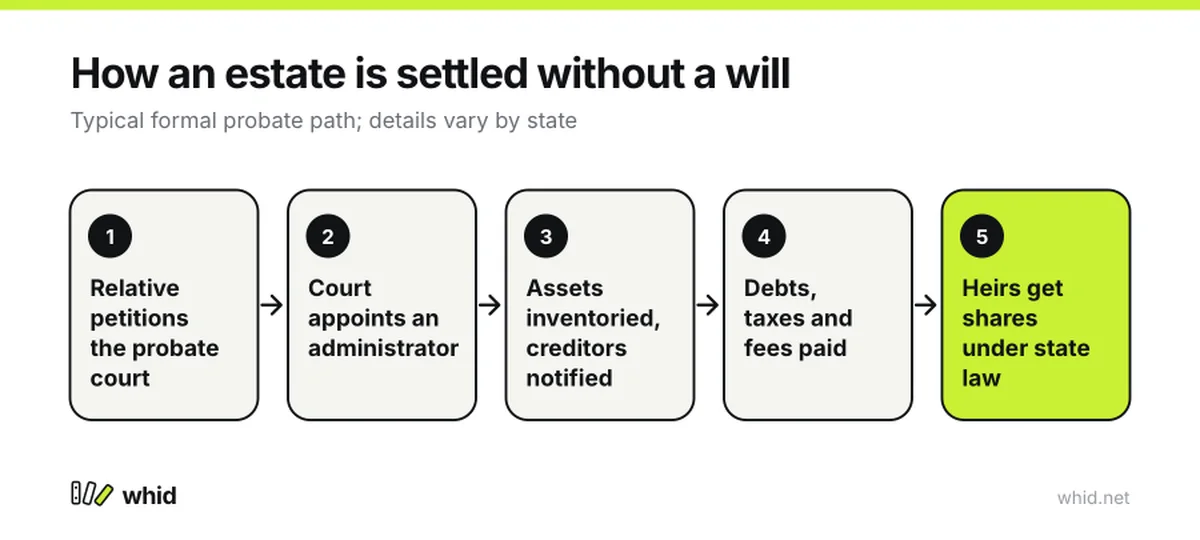
With no will, there's no executor you picked. A relative asks the probate court to be appointed as administrator (also called personal representative). In California, for example, priority goes to a surviving spouse or domestic partner first, then a child, a grandchild, a parent and a sibling. The administrator gathers assets, notifies creditors, pays debts and taxes, files reports with the court and finally distributes what's left to the heirs.
Some states may require the administrator to post a bond, a kind of insurance policy that protects the estate, which adds another cost a will can often waive.
How long and how much
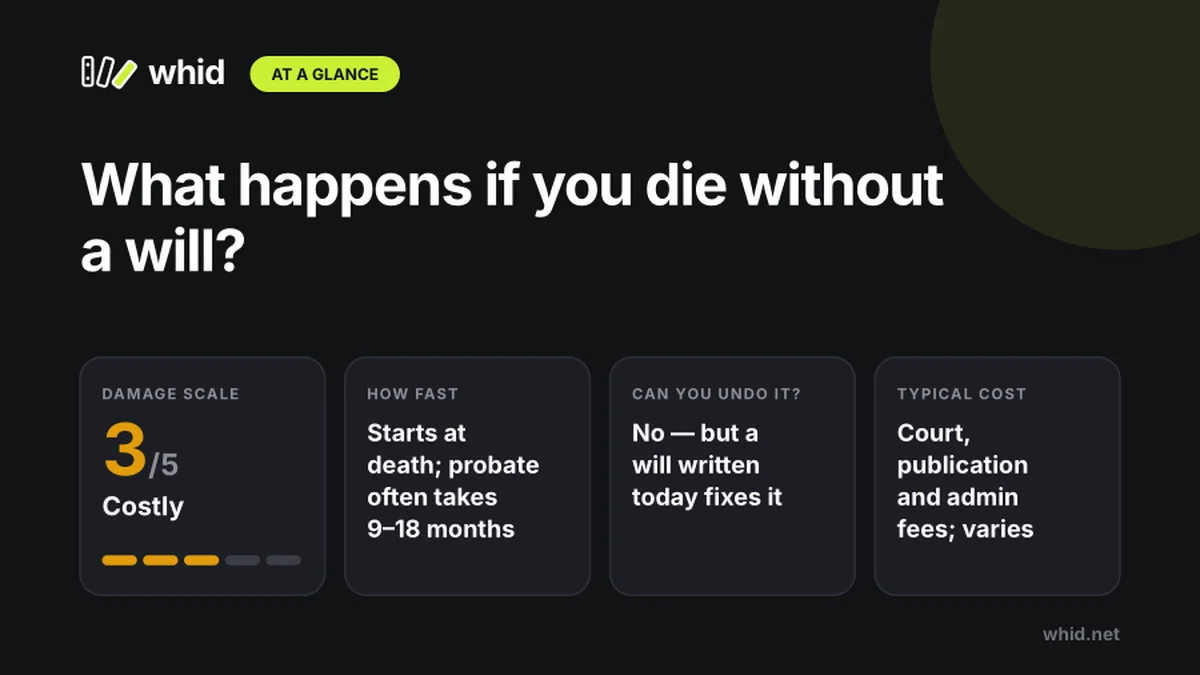
Formal probate is slow. California's court self-help guide says the process typically takes 9 to 18 months and can run longer, with filing, publication and appraisal costs often well over $1,000, plus statutory fees for the personal representative and any lawyer.
Smaller estates can often skip most of this. Many states offer a small-estate affidavit or summary procedure. California's limit for personal property, for deaths on or after April 1, 2025, is $208,850. Limits and rules differ widely, so check your state court's website.
If there's no family at all
If no qualifying relative can be found, the estate may escheat, meaning it passes to the state. That's rare, because most intestacy laws reach fairly distant relatives first, but it does happen.
What about your kids?
For parents of minors, this matters more than the money. A will is where you normally nominate a guardian. Without one, if no parent survives, a court picks a guardian based on the child's best interests, and relatives may disagree about who it should be. Money left to a minor may also need court-supervised management until the child becomes an adult.