whid

What happens if you don't file your taxes?

Skipping your tax return is far more expensive than filing and not paying. In the US, the failure-to-file penalty is ten times larger per month than the late-payment penalty — and if you're owed a refund, you could lose it entirely. Here's the timeline.

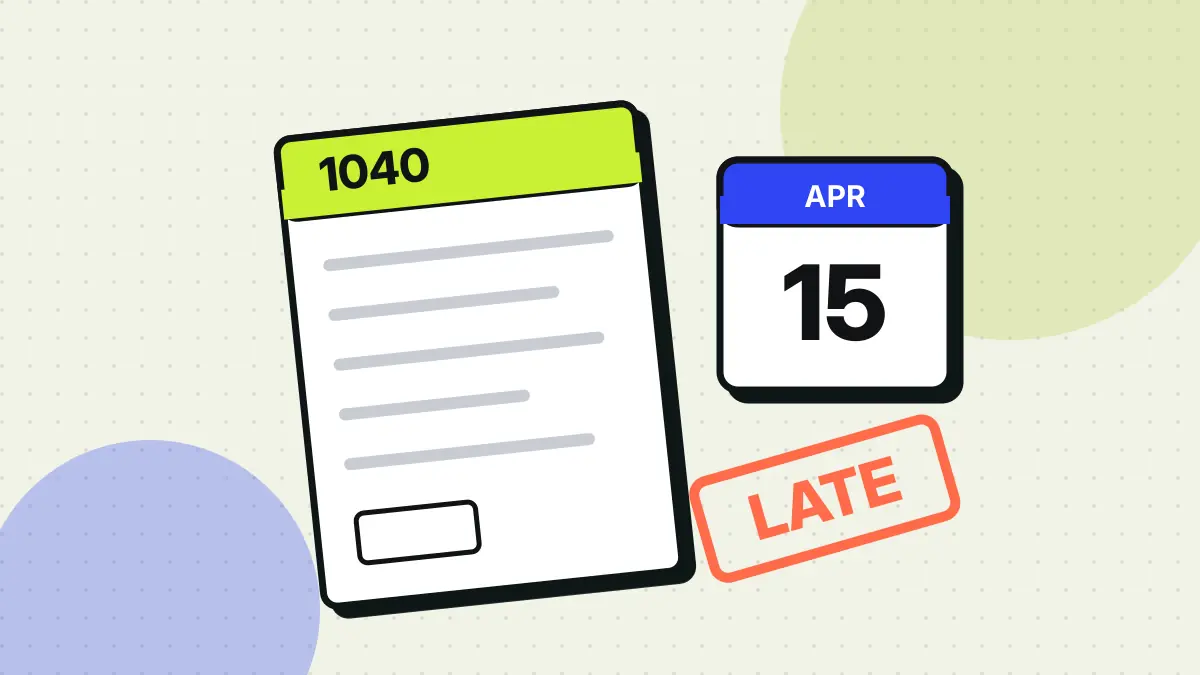
Illustration of a tax return form next to a calendar marked April 15 and a red LATE stamp
Illustration: whid
Damage scale 4/5 Serious
How fastPenalties start the day after the deadline
Can you undo it?Partly — filing stops the biggest penalty
Typical cost5% of unpaid tax per month, up to 25%, plus interest

The short answer

If you owe tax and don't file, the IRS charges a failure-to-file penalty of 5% of the unpaid tax for each month or part of a month, up to 25%, plus a separate late-payment penalty and interest. If your return is more than 60 days late, a minimum penalty applies — $525 or 100% of the tax owed, whichever is less, for returns due in 2026. Eventually the IRS can file a return for you and start collections. If you're owed a refund, there's no penalty — but you generally lose the refund if you don't claim it within three years.

On this page 11 sections
  1. Step by step
  2. Two different penalties
  3. The 60-day trap
  4. What if you're owed a refund?
  5. When the IRS files for you
  6. How to fix it
  7. Owe tax vs owed a refund
  8. What to do now
  9. Myth vs fact
  10. Reader stories
  11. Quick questions

01 What happens, step by step

  1. Day after the deadline

    Penalties begin

    Failure-to-file (5% per month) and failure-to-pay (0.5% per month) penalties start, plus interest on the balance.

  2. 60 days late

    Minimum penalty kicks in

    For returns due in 2026, the minimum failure-to-file penalty is the lesser of $525 or 100% of the tax owed.

  3. 5 months

    Filing penalty maxes out

    The failure-to-file penalty reaches its 25% cap. Interest and the late-payment penalty keep growing.

  4. Months to years

    IRS notices and a substitute return

    The IRS may send letters and prepare a "substitute for return" using your W-2s and 1099s — without the deductions and credits you might have claimed.

  5. After that

    Collections

    Unpaid tax can lead to liens, levies on bank accounts or wages, and seized refunds in future years.

Not filing a tax return often starts as procrastination: you're missing a document, you think you can't afford the bill, or you assume you're owed money anyway. The trouble is that the US tax system punishes not filing much harder than not paying.

Two different penalties

The IRS charges separate penalties for filing late and paying late. The failure-to-file penalty is 5% of the unpaid tax for each month or part of a month the return is late, up to 25%. The failure-to-pay penalty is only 0.5% per month. When both apply in the same month, the combined rate is 5%.
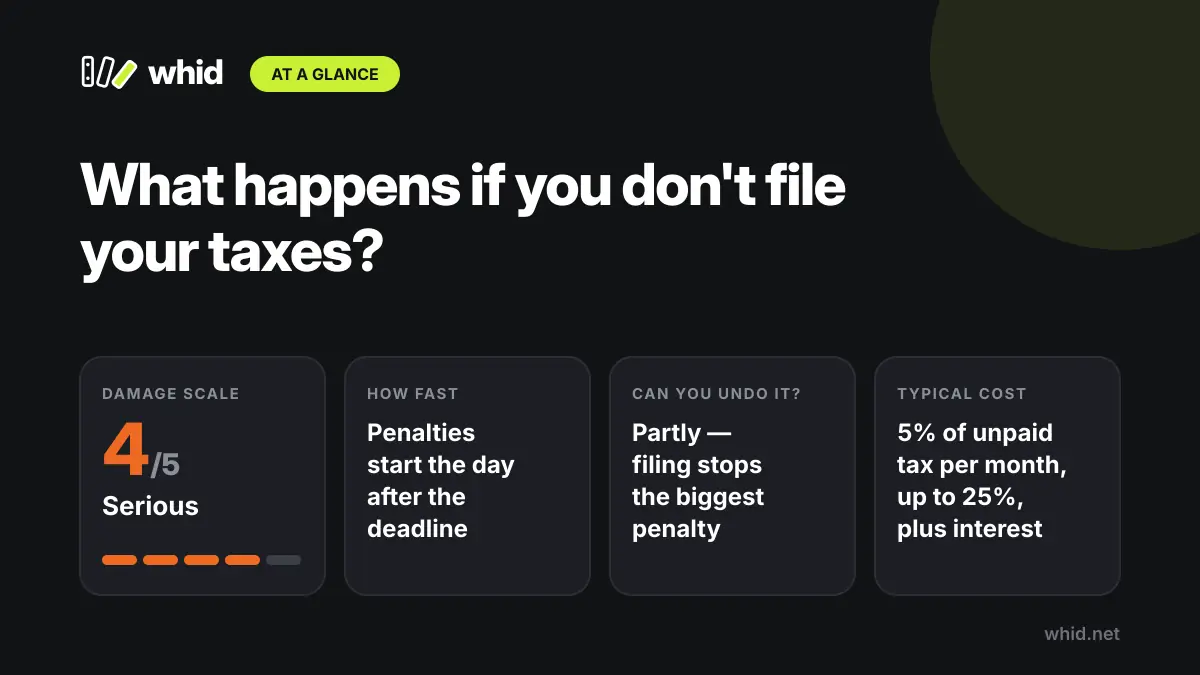
At a glance: What happens if you don't file your taxes? Damage scale 4/5 (Serious); how fast: Penalties start the day after the deadline; typical cost: 5% of unpaid tax per month, up to 25%, plus interest.
At a glance: the damage rating, how fast it happens, whether it can be undone and what it usually costs.

The practical lesson is simple: file on time even if you can't pay. Filing cuts your penalty rate by roughly 90% and opens the door to a payment plan.

The 60-day trap

Once a return is more than 60 days late, a minimum penalty applies. For returns required to be filed in 2026, it's the smaller of $525 or 100% of the tax owed. For someone with a small tax bill, that can mean the penalty equals the tax itself.
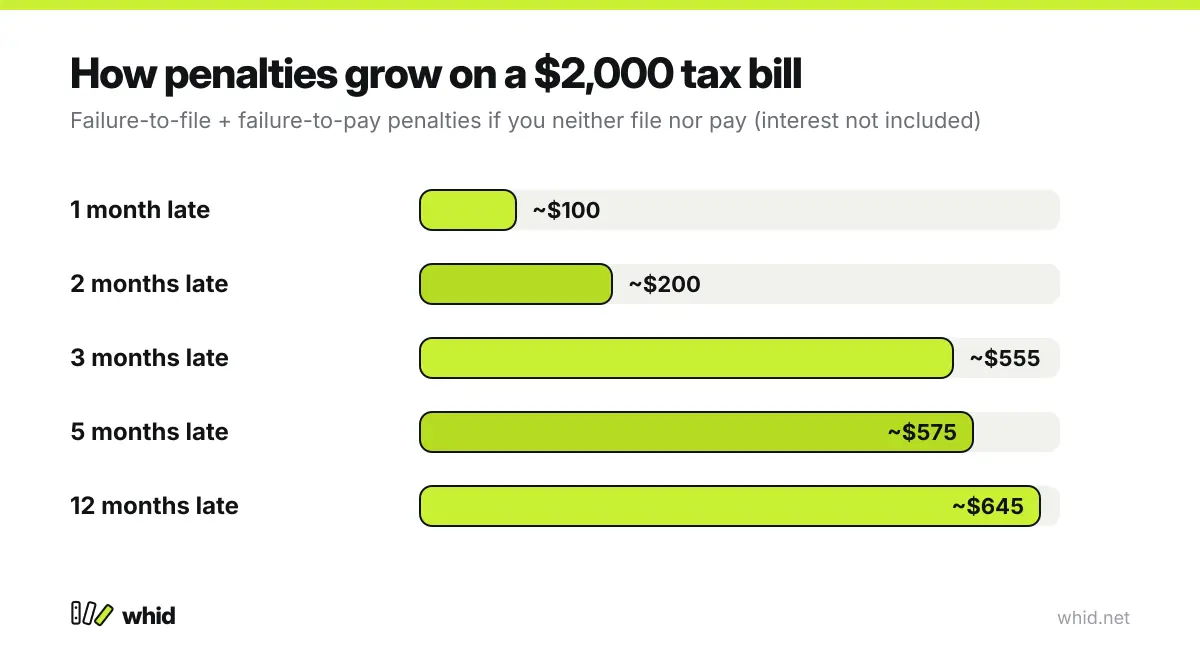
Extensions: an extension gives you more time to file, not more time to pay. Interest and the late-payment penalty still run from the original April deadline on any tax you owe.
Bar chart showing penalties on a $2,000 unpaid tax bill growing from about $100 after one month to about $645 after a year
Approximate example using rates for returns due in 2026: the $525 minimum failure-to-file penalty applies once the return is more than 60 days late.

What if you're owed a refund?

If the IRS owes you money, there's no penalty for filing late. But the clock still matters: you generally have three years from the original due date to claim a refund. After that, the money stays with the Treasury. People who skip filing because they "only had a small job" often leave hundreds of dollars — sometimes refundable credits worth thousands — unclaimed.

When the IRS files for you

If you ignore notices, the IRS can prepare a substitute for return based on the income reported by employers and banks. It won't include deductions or credits you may be entitled to, so the tax bill is often higher than if you'd filed yourself. That bill can then move into collections: federal tax liens, levies on bank accounts or wages, and future refunds taken to cover the debt.

How to fix it

File the missing return as soon as you can — the IRS website has prior-year forms, and tax software or a tax professional can help. If you can't pay in full, apply for a payment plan. If you had a good reason for being late, such as a serious illness, ask about penalty relief; first-time penalty abatement is also available to many taxpayers with a clean history.
02 Owe tax vs owed a refund

US federal rules for individual returns. State rules vary. Not tax advice.

SituationPenalty for not filingWhat to do
You owe tax and don't file5% per month (up to 25%) + late-payment penalty + interestFile as soon as possible, even if you can't pay
You owe tax, file on time, can't payOnly 0.5% per month + interestFile and set up a payment plan
You're owed a refund and don't fileNo penaltyFile within three years or lose the refund
Return over 60 days late, small tax billLesser of $525 or 100% of the taxFile now — the minimum penalty can double a small bill
Several years not filedPenalties on each year + possible substitute returnsGet professional help and file the missing years

03 What to do right now

  1. File the return now, even if you can't pay. This stops the 5%-per-month failure-to-file penalty from growing.
  2. Pay what you can today. Interest and penalties are calculated on the unpaid balance.
  3. Set up an IRS payment plan. Short- and long-term plans can be requested online for many taxpayers.
  4. Ask about penalty relief. First-time abatement or reasonable-cause relief may reduce penalties.
  5. Check for missed refunds. File any year where you may be owed money — within three years.

04 Myth vs fact

Myth If I can't pay, there's no point filing.

Fact Filing on time cuts your penalty from 5% to 0.5% per month and lets you set up a payment plan.

Myth If I'm owed a refund, I can file whenever I want.

Fact There's no penalty, but you generally lose the refund after three years.

Myth The IRS will forget about a small return.

Fact Employers and banks report your income to the IRS, which can prepare a substitute return for you.

05 Has this happened to you?

Real experiences from readers. Stories are checked by an editor before they appear and are not professional advice.

No reader stories yet — be the first to share yours.

Share what happened to you

By sending, you agree that we may publish your story (first name and location only). See our privacy policy.

06 Quick questions

How much is the penalty for filing taxes late?

5% of the unpaid tax per month or part of a month, up to 25%. If the return is more than 60 days late, a minimum penalty applies — for 2026 returns, the lesser of $525 or 100% of the tax owed.

Can you go to jail for not filing taxes?

Criminal prosecution is rare and usually reserved for wilful, repeated evasion. Most people face penalties, interest and collection actions instead.

Is there a penalty if I don't owe anything?

No failure-to-file penalty applies if you owe no tax, but you may lose any refund after three years.

Sources

  1. IRS — Topic no. 653, IRS notices and bills, penalties and interest charges
  2. IRS — Failure to file penalty
  3. IRS — Payment plans (installment agreements)

General information only. Laws, prices and procedures vary by location and change over time — check with a qualified professional for your situation. Full disclaimer.