whid

What happens if you get struck by lightning?

About 90% of people struck by lightning survive — but the strike can stop the heart in an instant and leave nerve damage that lasts for years. Here is what happens to the body, second by second, and how to help someone who has been hit.

Illustration of a storm cloud sending a lime-green lightning bolt down to the ground
Illustration: whid
Damage scale 5/5 Dangerous
How fastInstant — the strike lasts a fraction of a second
Can you undo it?Most people survive, but injuries can be lifelong
Typical costEmergency care; long-term rehab for some survivors

The short answer

A lightning strike sends a huge electrical current across or through the body in less than a second. The biggest danger is cardiac arrest: the heart can simply stop. According to the US National Weather Service, only about 10% of people who are struck are killed, but many survivors live with burns, hearing damage, chronic pain or memory problems. Victims carry no electrical charge — it is safe to touch them, so call 911 and start CPR right away if they are not breathing.

On this page 9 sections
  1. Step by step
  2. Why the heart is the weak point
  3. The injuries survivors live with
  4. Where you are actually safe
  5. The five ways lightning hits people
  6. What to do now
  7. Myth vs fact
  8. Reader stories
  9. Quick questions

01 What happens, step by step

  1. 0 sec

    The current arrives

    Lightning carries tens of thousands of amps. Much of it can flash over the outside of the body, but some passes through the nervous system and heart.

  2. < 1 sec

    Heart and breathing can stop

    The current can reset the heart's rhythm and knock out the brain's breathing centre. This is what makes lightning deadly.

  3. Seconds

    Burns and blast effects

    Clothes may tear, metal objects heat up, and the shock wave can rupture eardrums or throw the person several feet.

  4. Minutes

    CPR window

    Without breathing and a heartbeat, brain damage begins within minutes. Bystander CPR is the single biggest factor in survival.

  5. Days–years

    Hidden injuries

    Many survivors report nerve pain, headaches, sleep problems, memory loss or personality changes that appear later and need long-term care.

Lightning feels like a freak event, but it is surprisingly predictable. It strikes the US millions of times a year, peaks on summer afternoons and claims victims who are usually outdoors doing something ordinary — fishing, walking the dog, finishing a round of golf. Knowing what a strike does to the body explains both why it can kill and why most people survive.

A lightning bolt carries an enormous current for a tiny fraction of a second. Because the strike is so short, much of the energy often flashes over the surface of the skin instead of cooking the body from the inside, which is why lightning victims rarely have the massive internal burns seen in high-voltage industrial accidents. The real threat is electrical, not thermal.
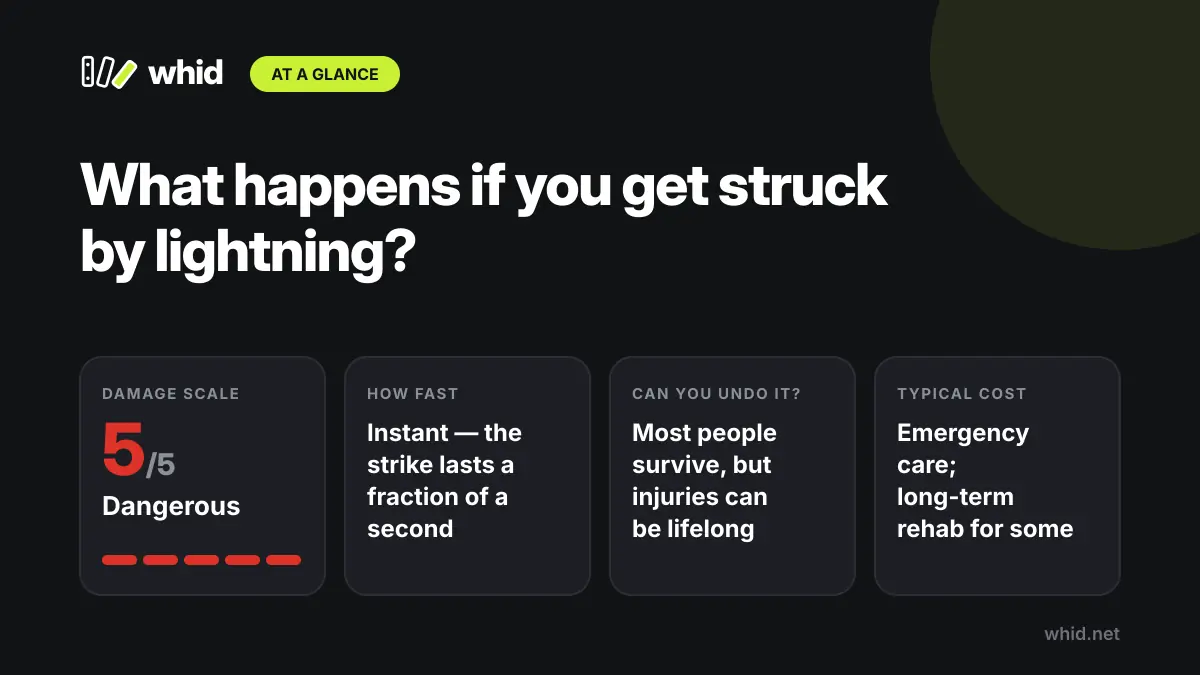
At a glance: What happens if you get struck by lightning? Damage scale 5/5 (Dangerous); how fast: Instant — the strike lasts a fraction of a second; typical cost: Emergency care; long-term rehab for some survivors.
At a glance: the damage rating, how fast it happens, whether it can be undone and what it usually costs.

Why the heart is the weak point

Your heart and breathing are controlled by electrical signals. A massive pulse of outside current can scramble those signals in an instant. The heart may stop entirely, and the part of the brain that drives breathing can shut down. Here is the important part: the heart sometimes restarts on its own, but breathing often does not. Without help, the lack of oxygen then stops the heart a second time.

That is why survival is closely linked to how quickly someone starts CPR. Victims do not stay "electrified" — touching them is completely safe. If a group of people is struck, the medical advice is to treat first those who look dead, because people who are moving and talking are already breathing.

The injuries survivors live with

About nine out of ten people struck by lightning survive, but many do not walk away unchanged. Common effects include:

  • Burns — often in lines or spots where sweat, rain or metal (jewellery, phone, belt buckle) conducted the current.
  • Lichtenberg figures — striking fern-like red patterns on the skin that fade within hours or days.
  • Ear and eye damage — ruptured eardrums, hearing loss, and cataracts that can appear months later.
  • Nerve and brain injury — chronic pain, numbness, sleep disorders, memory and concentration problems, depression and irritability.

Because some of these symptoms are invisible or delayed, survivors are often told they look fine while they struggle for years. Lightning survivor support groups exist for exactly this reason.
The 30-30 idea, updated: safety agencies now simply say "When thunder roars, go indoors." If you can hear thunder, you are close enough to be struck. Wait 30 minutes after the last thunder before going back outside.
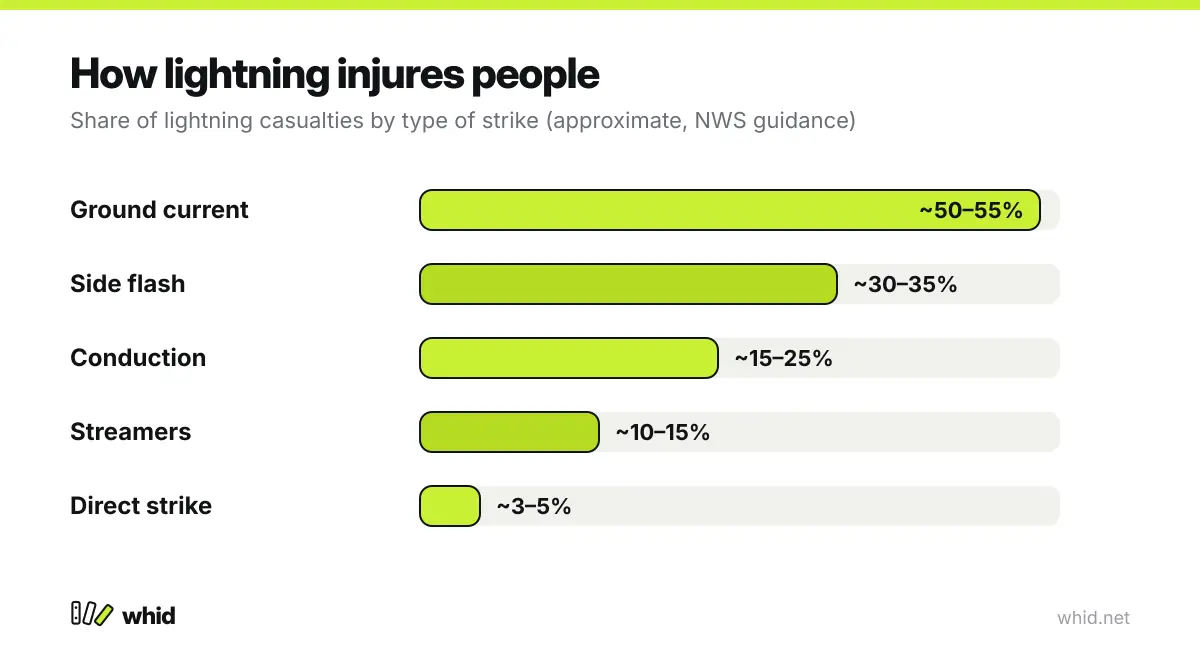
Bar chart showing that ground current causes the most lightning injuries and direct strikes the fewest
Most lightning victims are hurt by ground current or side flashes, not by a direct hit.

Where you are actually safe

Safe shelter means a fully enclosed building with wiring and plumbing, or a hard-topped metal vehicle with the windows up. Picnic shelters, tents, open garages, golf carts and trees do not protect you; trees in particular cause side flashes. Indoors, stay off corded phones and away from plumbing and electrical equipment during the storm, because current can travel through them.

If you are caught outside with no shelter, there is no truly safe option — but moving away from hilltops, open fields, water and tall isolated objects lowers the risk. Do not lie flat on the ground, as that increases your contact with ground current.

02 The five ways lightning hits people

Based on the National Weather Service's lightning safety guidance. Most victims are not hit by a direct strike.

Type of strikeWhat happensHow common
Ground currentThe strike spreads through the ground and up through the legsThe most common cause of deaths and injuries
Side flash (side splash)Current jumps from a tall object, like a tree, to a person nearbyCommon — why trees are dangerous shelters
ConductionCurrent travels along wires, pipes or fences the person is touchingMost indoor injuries
StreamersAn upward "streamer" from the body is part of a nearby strike's pathLess common
Direct strikeThe bolt hits the person directlyThe rarest, usually in open areas

03 What to do right now

  1. Call 911 (or your local emergency number) immediately. Lightning injuries always need medical assessment, even if the person seems fine.
  2. Check breathing and start CPR if needed. It is safe to touch the victim. Use an AED if one is available.
  3. Move to a safer spot if the storm is still active. Lightning can strike the same place twice. Move the victim only if it is safe to do so.
  4. Treat the "dead-looking" victims first in a group. People who are moving and talking are already breathing.
  5. Get follow-up care. Ask for hearing and eye checks, and report new pain, sleep or memory problems in the weeks after.

04 Myth vs fact

Myth Lightning never strikes the same place twice.

Fact It often does. Tall structures like the Empire State Building are hit many times a year.

Myth A lightning victim stays electrified and is dangerous to touch.

Fact The human body does not store electricity. Touching a victim to give first aid is safe.

Myth Rubber tyres protect you in a car.

Fact A hard-topped metal car protects you because the metal shell carries the current around you — not because of the tyres.

05 Has this happened to you?

Real experiences from readers. Stories are checked by an editor before they appear and are not professional advice.

No reader stories yet — be the first to share yours.

Share what happened to you

By sending, you agree that we may publish your story (first name and location only). See our privacy policy.

06 Quick questions

What are the odds of being struck by lightning?

The National Weather Service estimates the odds of being struck in a given year at roughly 1 in 1.2 million, and about 1 in 15,300 over an 80-year lifetime.

Can you survive a direct lightning strike?

Yes. Most people struck by lightning survive, including some direct strikes, especially when CPR is started quickly. Long-term injuries are common, though.

Is it safe to shower during a thunderstorm?

It is best to avoid it. Lightning can travel through metal plumbing and water, so stay out of the shower and bath until the storm passes.

How far away can lightning strike?

Lightning can strike several miles from the storm, sometimes under clear sky. If you can hear thunder, you are within striking distance.

Sources

  1. National Weather Service — How dangerous is lightning? (odds and statistics)
  2. National Weather Service — Lightning safety
  3. CDC — Lightning safety and first aid

General information only. Laws, prices and procedures vary by location and change over time — check with a qualified professional for your situation. Full disclaimer.