Few things turn a party table into a movie set as fast as a bowl of water and a few chunks of dry ice. The fog looks like smoke, but it is actually water — and the science behind it explains both why it's so dramatic and why a few rules matter.
What dry ice is
Dry ice is solid carbon dioxide, the same gas you breathe out. At normal air pressure it can't exist as a liquid, so instead of melting it turns directly into gas — a process called sublimation. It does this at about −78.5 °C (−109.3 °F), far colder than ordinary ice.

Left on a plate, a block of dry ice slowly shrinks and gives off a light vapour. Put it in water and that process speeds up dramatically, because water transfers heat far better than air.
Where the fog comes from
The carbon dioxide gas itself is invisible. What you see is water. The bubbles of freezing-cold CO₂ chill the air just above the surface so much that the water vapour in it condenses into billions of tiny droplets — a cloud, basically. Because cold CO₂ is heavier than air, the cloud hugs the table and pours over the edge of the bowl.
The warmer the water, the faster the dry ice sublimates and the thicker the fog. Ice-cold water gives you a lazy wisp; hot tap water gives you a rolling wave. As the water cools and a crust of ordinary ice forms around the pellets, the effect fades — adding warm water brings it back.
The three real dangers
1. Cold burns
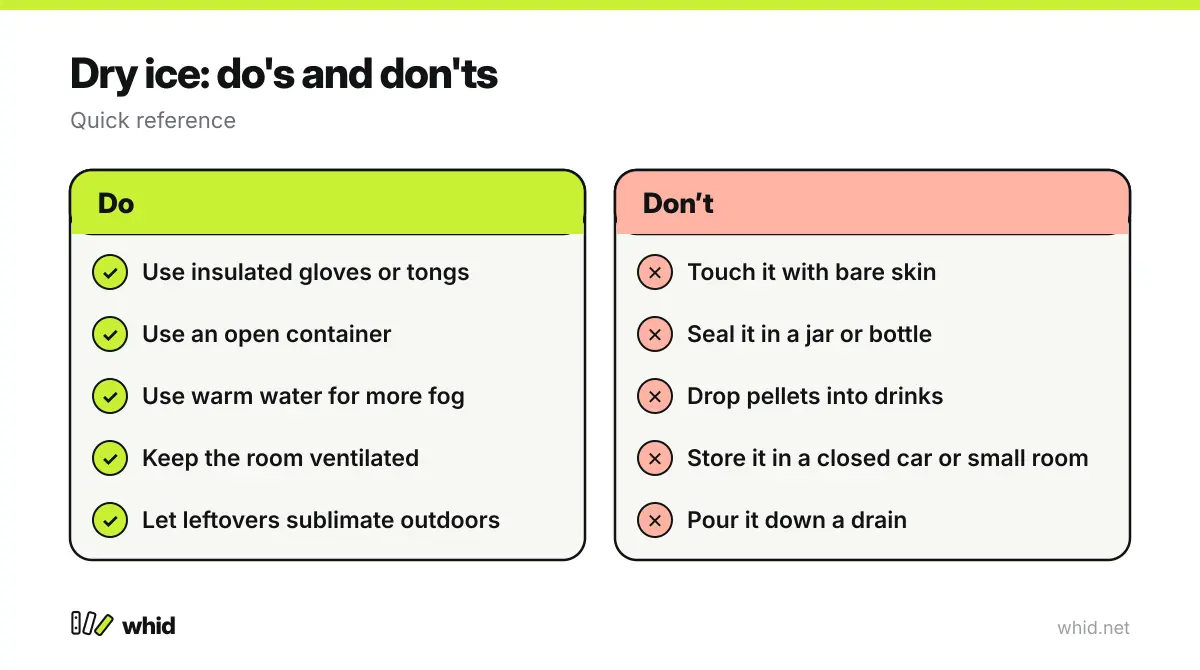
Dry ice is cold enough to damage skin in seconds. Use insulated gloves or tongs, never hold it in your bare hand, and keep it away from children.
2. Pressure
Because it turns into a lot of gas, dry ice must be stored in a container that can vent — a polystyrene cooler with a loose lid works. Never put it in an airtight container, a glass jar or a plastic bottle.
3. Carbon dioxide build-up
Carbon dioxide displaces oxygen. In a large, ventilated room the small amount from a fog bowl is harmless, but large quantities in a small space — a closed car, a basement, a walk-in cooler — can cause headaches, dizziness and, in extreme cases, unconsciousness. Drive with a window open when transporting dry ice.
Dry ice in drinks
Smoking cocktails look great, but swallowing a pellet of dry ice can cause serious internal burns and gas expansion. If you use dry ice for drinks at all, use a product designed for it that keeps the ice separate from the liquid — and never serve it to children.