whid

What happens if you bypass your water softener for weeks?

Bypass mode is meant to be used, but leaving it on for weeks has side effects. What changes immediately, what sitting idle does to the resin, and how to shut down and restart properly.

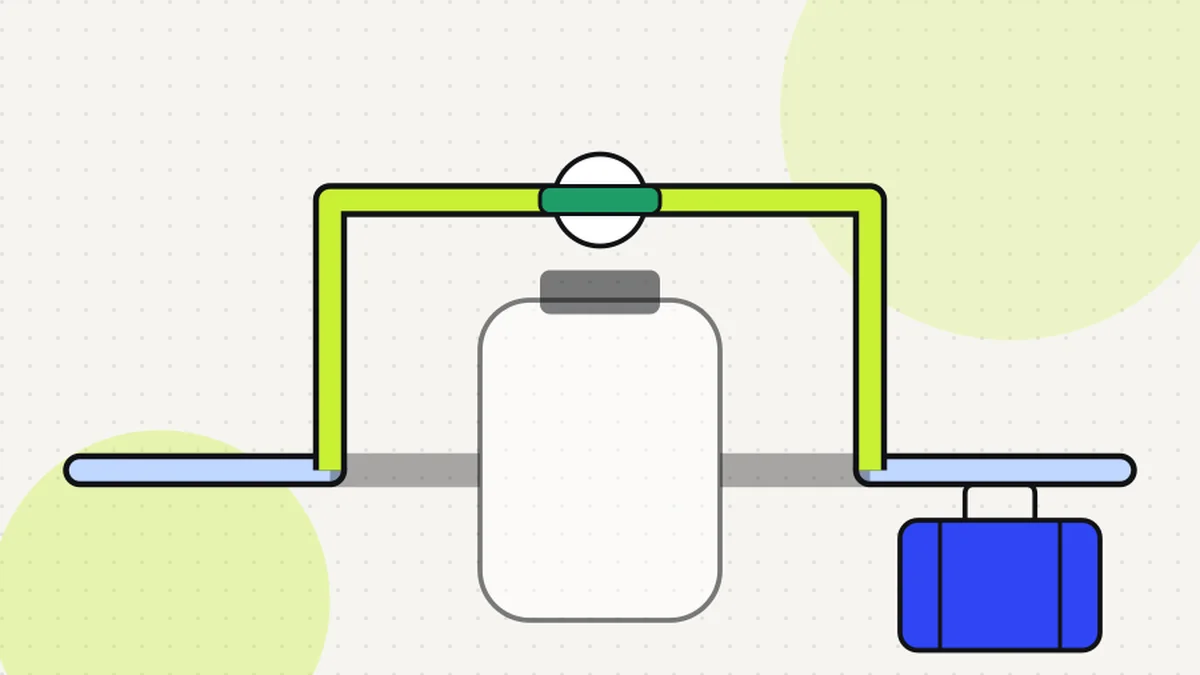
Water pipes with a bright bypass loop skipping a faded water softener tank, an open green valve handle and a suitcase
Illustration: whid
Damage scale 2/5 Annoying
How fastHard water at once
Can you undo it?Yes: regenerate on return
Typical costUsually $0

The short answer

Your whole house gets hard water straight away, and the softener just sits. A few days is harmless. After about two weeks the still water in the resin tank loses its chlorine and bacteria can start to grow, and a timer-based unit may keep regenerating while bypassed. For long absences, regenerate before you leave, bypass and unplug it, then run a manual regeneration and flush the taps when you get back.

On this page 12 sections
  1. Step by step
  2. What changes the moment you turn the valve
  3. After two weeks: the still-water problem
  4. The mistake to avoid: water off, power on
  5. Using bypass for the lawn, a pool or a repair
  6. How to shut down for a long absence
  7. How to bring it back
  8. What to do with a softener while you are away
  9. What to do now
  10. Myth vs fact
  11. Reader stories
  12. Quick questions

01 What happens, step by step

  1. Minute 0

    Valve turned to bypass

    Raw water reaches every tap. The softener stops treating water.

  2. Days 1–3

    Hard water signs return

    Spots, poor lather and scale in the water heater start again.

  3. On schedule

    Timer units keep cycling

    A timed softener regenerates on the clock unless it is unplugged, wasting salt and water.

  4. Week 2+

    Still water goes stale

    Chlorine fades in the resin tank. Bacteria and odors become possible.

  5. On return

    Regenerate and flush

    A manual regeneration clears stale water. Run a cold tap for a few minutes.

The bypass valve is there to be used. Plumbers flip it during repairs, people use it when they fill a pool or water the lawn, and plenty of owners turn it before a long trip. It sends incoming water around the softener instead of through it, so the house keeps running while the softener is out of the loop. The question is what happens when "for a bit" turns into weeks.

The short version is that nothing breaks and most of the effects are easy to undo. A few of them, though, catch people off guard, especially in homes with older timer-based softeners or a softener on well water.
At a glance: What happens if you bypass your water softener for weeks? Damage scale 2/5 (Annoying); how fast: Hard water at once; typical cost: Usually $0.
At a glance: the damage rating, how fast it happens, whether it can be undone and what it usually costs.

What changes the moment you turn the valve

Every tap in the house gets your raw water. If your supply is hard, the spots, poor lather and soap scum return within a day or two, and the water heater starts collecting scale again. That is the whole point of bypass, so it is not a fault. It is worth remembering if you bypassed for a garden job and forgot to switch back. Plenty of people discover the valve still in bypass months later, after wondering why the softener has stopped working.
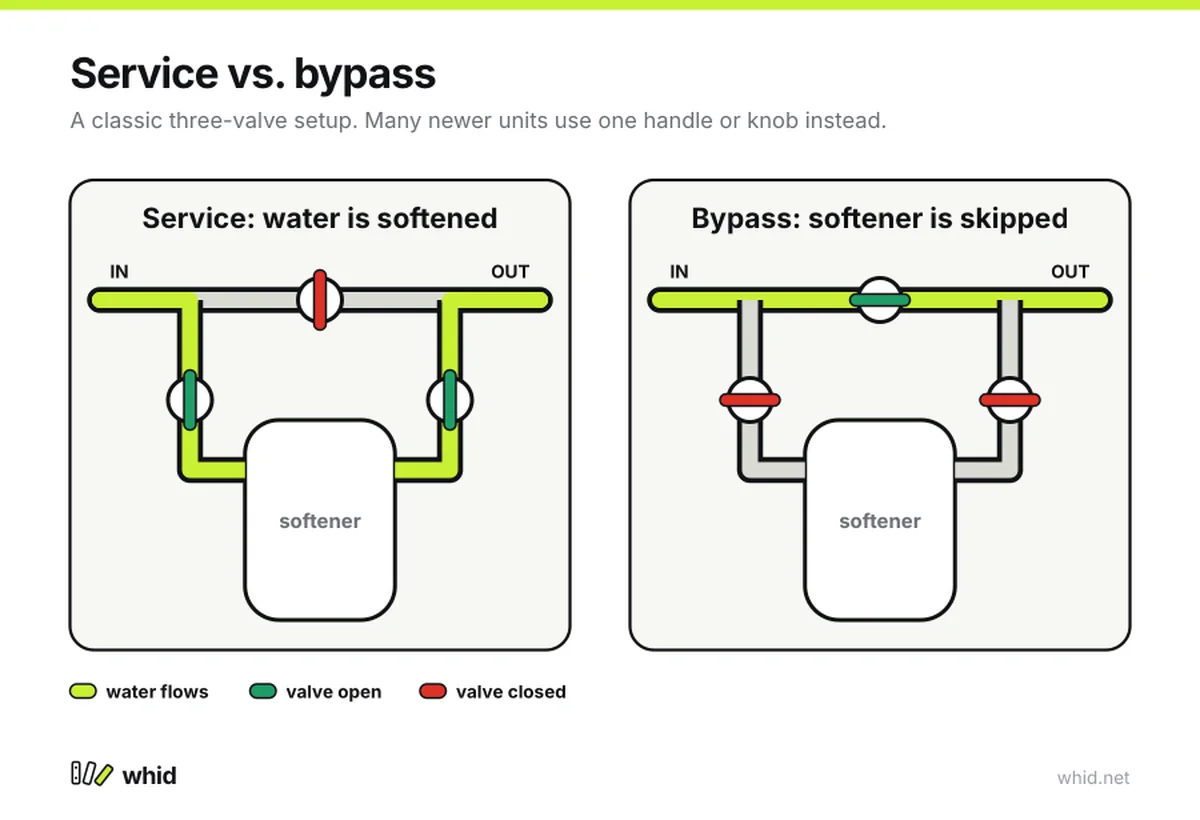
Diagram comparing a water softener in service mode, with water flowing through the tank, and in bypass mode, with water flowing around it
In bypass, the inlet and outlet valves close and the middle valve opens, so water skips the softener.

The softener itself goes quiet, but not always completely. A metered unit counts gallons, and with no water flowing through it, it has nothing to count, so it does not regenerate. A timer-based unit regenerates on the clock whatever you are doing. GE Appliances notes that its timed model will still regenerate while you are away, and tells owners to unplug it to stop that. Every one of those cycles uses salt and sends water down the drain for nothing.

After two weeks: the still-water problem

The resin tank is full of water at all times, and in bypass that water does not move. City water carries a small amount of chlorine or chloramine that keeps bacteria in check. In a tank that sits for weeks, that protection fades, and bacteria have a warm, dark bed of plastic beads with plenty of surface area to settle on. Several water treatment guides put the practical limit at about two weeks before this is worth worrying about.

This is rarely dangerous for a city water supply. It mostly shows up as a musty or slightly odd smell the first time water runs through the softener again. Well water is a different story because it often has no disinfectant at all and may contain iron, which sticks to idle resin and is harder to wash off later. For a well, a long bypass deserves a little more care.

The brine tank sits idle too. Humidity in a basement or garage can fuse the top layer of salt into a crust, so a tank that was fine when you left can greet you with a salt bridge.

The mistake to avoid: water off, power on

Many people shut off the main water supply before a long trip, which is sensible. If you do that and leave a timer softener plugged in, it will try to regenerate with no water pressure behind it. The cycle cannot backwash or draw brine properly, and on some units it can leave the valve in an odd position or pull air into the system. The fix is simple: if the water is off, the softener should be unplugged too.

Using bypass for the lawn, a pool or a repair

Short bypasses are where the valve earns its keep. Plants do not need softened water, and filling a pool or running sprinklers through a softener burns through salt and resin capacity for nothing. Turning the valve for a few hours saves money and does the softener no harm at all.

The same goes for plumbing work. A plumber replacing a water heater or a faucet will usually bypass the softener so debris and air from the job do not end up in the resin tank. Once the work is done and the lines have been flushed, switch back to service.

The only real risk with short bypasses is forgetting. A piece of tape on the valve, or a phone reminder for the evening, solves that.

How to shut down for a long absence

How much you do depends on how long you will be gone. For a long weekend, leave a metered softener alone. For one to two weeks, unplug a timer unit or put it in vacation mode if it has one. For longer trips, run a manual regeneration a day before you leave so the resin starts clean, then turn the bypass, unplug the unit and write down any settings that might not survive a power cut. If you are away for months, especially on a well, follow the manufacturer's long-term storage steps. Some recommend leaving the resin in brine while it sits.
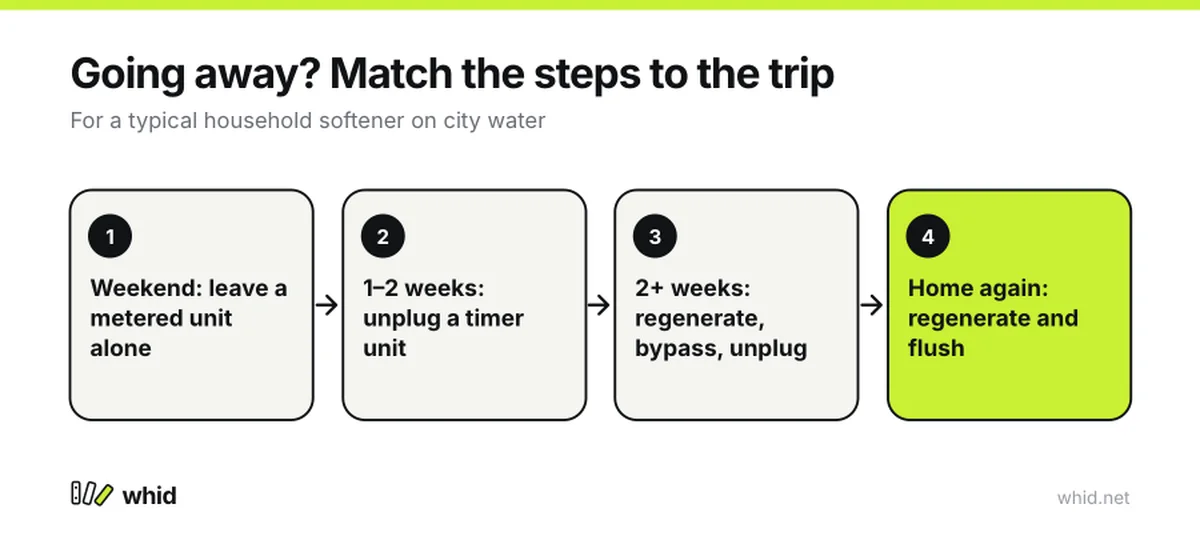
Four-step guide: leave a softener alone for a weekend, unplug timers for one to two weeks, regenerate, bypass and unplug for longer trips, regenerate on return
The longer the trip, the more you do before you leave.

How to bring it back

Plug the softener in and set the clock if it has lost the time. Return the valve to service slowly, because opening it all at once can stir up the resin and hammer the pipes. Check the salt for a crust, top it up if needed, and start a manual regeneration. That cycle flushes the stale water and recharges the beads in one go. Afterwards, run a cold tap for a few minutes to clear what was sitting in the lines. If you notice a smell that does not go away after a second regeneration, a resin cleaner or a call to a water treatment technician is the next step.
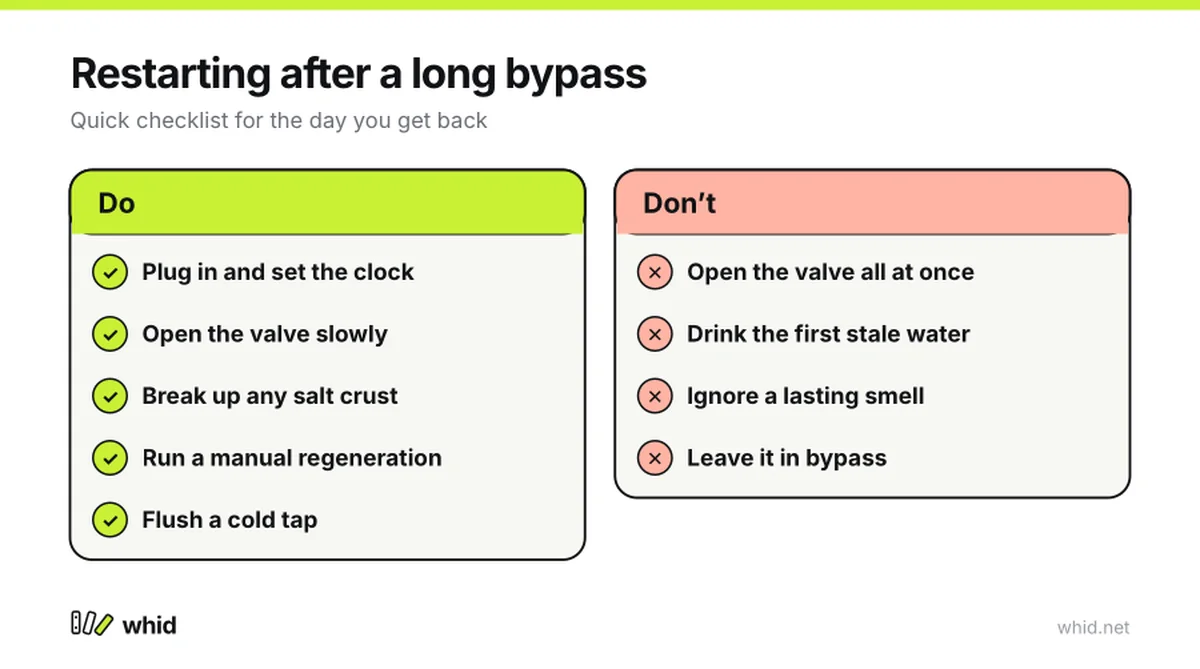
Checklist for restarting a water softener after bypass: plug in, open slowly, check salt, regenerate and flush
Ten minutes of work, and the softener is back where it was.

02 What to do with a softener while you are away

General guidance. Your manual takes priority, especially for well water and long-term storage.

How longMetered softenerTimer softenerIf the main water is off
A few daysLeave it runningLeave it, or unplugUnplug it
1–2 weeksLeave it runningUnplug or vacation modeUnplug it
2 weeks to a monthRegenerate, bypass, unplugRegenerate, bypass, unplugBypass and unplug
MonthsFollow storage steps in manualFollow storage steps in manualBypass, unplug, consider a pro

03 What to do right now

  1. Know which type you have Metered units only regenerate after water use. Timer units regenerate on a schedule, even in bypass.
  2. Regenerate before a long trip Starting with clean resin means less for bacteria to work with while it sits.
  3. Water off means power off Never leave a softener plugged in when the main supply is shut off.
  4. Reopen slowly Turn the valve back to service gradually to avoid stirring up the resin bed.
  5. Regenerate and flush on return Run a manual cycle, then let a cold tap run for a few minutes.

04 Myth vs fact

Myth Bypass mode erases your settings.

Fact Bypass only reroutes water. Unplugging may reset the clock on some models, so note your settings first.

Myth A bypassed softener uses no salt.

Fact Timer units keep regenerating on schedule unless you unplug them.

Myth Idle resin is ruined after a month.

Fact Resin usually recovers with a regeneration. Odor is the most common side effect.

05 Has this happened to you?

Real experiences from readers. Stories are checked by an editor before they appear and are not professional advice.

No reader stories yet — be the first to share yours.

Share what happened to you

By sending, you agree that we may publish your story (first name and location only). See our privacy policy.

06 Quick questions

How long can a water softener stay in bypass?

A few days to two weeks is no problem. Beyond that, regenerate before and after, and unplug timer units.

Should I turn off my water softener when I go on vacation?

For short trips, a metered softener can stay on. For longer trips, regenerate, bypass and unplug it.

Why does my water smell after the softener was off?

Stale water and bacteria in the resin tank. A manual regeneration usually clears it. If not, use a resin cleaner.

Can I bypass the softener to water the lawn?

Yes. It saves salt, since plants do not need soft water. Just remember to switch back.

Sources

  1. GE Appliances – Softener maintenance when you go on vacation
  2. Water Filter Guru – How to turn off a water softener
  3. Aquatell – Can I just turn off my water softener?
  4. USGS – Water hardness

General information only. Laws, prices and procedures vary by location and change over time — check with a qualified professional for your situation. Full disclaimer.