whid

What happens if you pour grease down the drain?

What happens if you pour grease down the drain? It hardens in your pipes, traps food and debris, and can cause clogs and sewage backups. Here's what to do.

Flat illustration of a frying pan dripping golden grease into a kitchen sink, with grease building up in the U-shaped pipe below, next to a sealed container and a can.
Illustration: whid
Damage scale 3/5 Costly
How fastSlow buildup over weeks to months, then a sudden clog
Can you undo it?Usually — if you catch it before a sewer backup
Typical costDrain cleaning to sewage cleanup, often on you

The short answer

Warm grease looks harmless going down, but as it cools it sticks to the inside of your pipes and the sewer line beyond them. Layer by layer it narrows the pipe until water backs up. The worst case is raw sewage coming back into your home, and that cleanup is often the homeowner's bill. Hot water, dish soap and the garbage disposal don't fix it — they just move the grease farther down the line.

On this page 11 sections
  1. Step by step
  2. What grease does inside a pipe
  3. Why hot water and soap don't solve it
  4. When it becomes a sewer problem
  5. Who pays for the damage
  6. The right way to get rid of grease
  7. Different kinds of grease, different risks
  8. What to do now
  9. Myth vs fact
  10. Reader stories
  11. Quick questions

01 What happens, step by step

  1. First pour

    Grease goes down warm

    It flows easily while hot, so nothing seems wrong.

  2. Minutes

    It cools and sticks

    In cooler pipes the grease firms up and coats the pipe walls.

  3. Weeks to months

    The coating grows

    Food bits and debris stick to the grease and the opening narrows.

  4. Months

    Slow drain and gurgling

    The kitchen sink drains slowly or backs up when the dishwasher runs.

  5. Worst case

    Full blockage or backup

    Wastewater backs up into the house or overflows from the sewer outside.

Pouring the bacon fat or leftover frying oil into the sink is one of the most common kitchen habits in America, and one of the most expensive in the long run. Nothing happens the first time. The damage is cumulative, which is exactly why people keep doing it.

Fats, oils and grease — utility companies shorten it to FOG — come from more than the frying pan. Butter, lard, shortening, meat drippings, gravy, mayonnaise, salad dressing, sauces and dairy all count. Even the film on a greasy plate adds up when it's rinsed off every night.
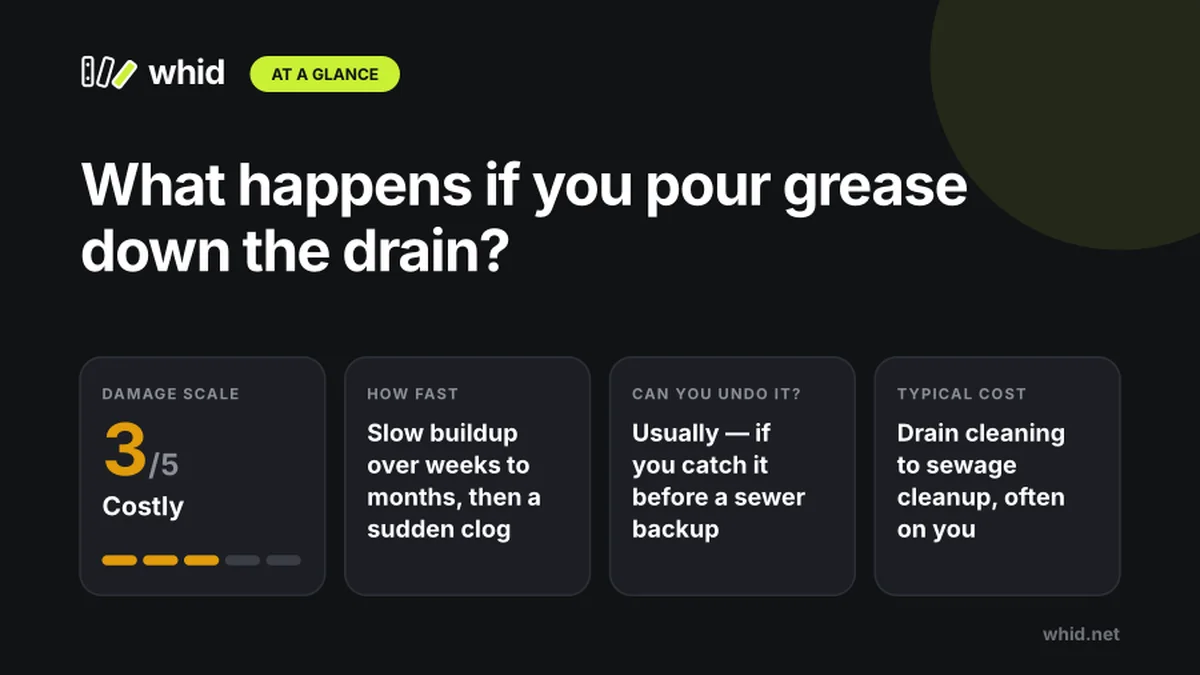
At a glance: What happens if you pour grease down the drain? Damage scale 3/5 (Costly); how fast: Slow buildup over weeks to months, then a sudden clog; typical cost: Drain cleaning to sewage cleanup, often on you.
At a glance: the damage rating, how fast it happens, whether it can be undone and what it usually costs.

What grease does inside a pipe

Grease travels as a liquid only while it's warm. Drain pipes and sewer lines are cool, so it quickly firms up and clings to the pipe walls. That sticky coating catches food scraps, coffee grounds and anything else that washes past, and the layer thickens. Over months, the opening inside the pipe gets smaller until it can't carry normal flow.

The first sign is usually a slow kitchen sink. Then the sink gurgles or backs up when the dishwasher drains. If the blockage forms farther down, in the line that runs from your house to the street, other fixtures can be affected too, starting with the lowest drains in the house.

Why hot water and soap don't solve it

Running hot water or squirting dish soap after the grease feels like a fix, but it only breaks the grease up temporarily. Once it cools again a few feet or a few blocks away, it re-forms and sticks. You haven't removed the problem; you've moved it somewhere harder to reach. Sanitation districts also warn that some drain additives sold to dissolve grease simply push it down the line. A garbage disposal grinds food, but it does nothing to keep grease out of the plumbing.
Septic owners: grease is hard on septic systems too. It can build up in the tank and drain field, leading to more frequent pump-outs and, in bad cases, system problems that are costly to repair.
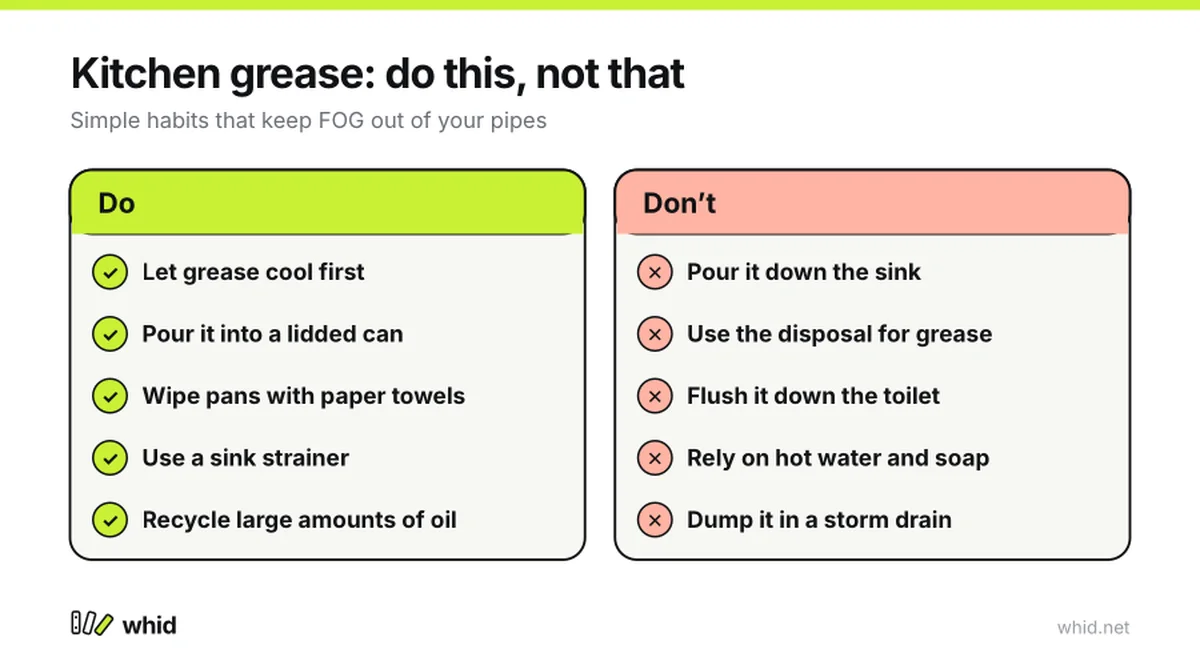
Two-column graphic listing five things to do with kitchen grease, like pouring it into a lidded can, and five things to avoid, like pouring it down the sink.
Most grease clogs are preventable with a can by the stove and a paper towel.

When it becomes a sewer problem

Grease from homes and restaurants is one of the leading causes of sewer clogs nationwide. An EPA fact sheet, cited by Clemson University's Home and Garden Information Center, attributes 47% of reported sewer blockages to grease. When a sewer main clogs, wastewater has to go somewhere: up through manholes into streets and yards, into storm drains and local waterways, or back into homes through floor drains and toilets.

Raw sewage carries bacteria and other pathogens, so a backup is a health hazard, not just a mess. Texas environmental regulators note that communities spend large sums every year clearing grease-blocked pipes and cleaning up spills, and those costs ultimately land on ratepayers.

Sewage backup: if wastewater is coming up into your home, stop using water, keep kids and pets away, and call a plumber and your local sewer utility. Avoid touching sewage without gloves and boots.

Who pays for the damage

In many US cities, the property owner is responsible for the pipes inside the home and often for the private sewer line that runs to the public main. A clog in your own plumbing is your plumber's bill. Sewage cleanup inside a house is often paid by the homeowner as well. Many standard homeowners policies limit or exclude sewer backup unless you've added specific coverage, so check your policy before you need it.

The right way to get rid of grease

Let it cool, pour or scrape it into a container you're throwing away anyway — an empty can, a milk carton, a jar — and put it in the trash once it's sealed or solid. Wipe greasy pans with a paper towel before washing. For large amounts, such as turkey fryer oil, check whether your city has a household hazardous waste site or cooking oil recycling drop-off.

02 Different kinds of grease, different risks

General guidance. Local rules and costs vary — check your sewer utility.

SituationWhat tends to happenWhat to do
A spoonful of grease, onceLittle immediate effect, but it adds to buildupWipe pans first next time
Rinsing greasy dishes nightlySteady coating builds inside the drainScrape and wipe plates before washing
Pouring a pan of frying oilLarge deposit that can clog quicklyCool it, seal it, put it in the trash
Turkey fryer or deep-fryer oilGallons of oil — a serious clog riskUse a recycling or hazardous waste drop-off
Home on a septic systemGrease builds up in the tank and drain fieldKeep grease out; follow your pumping schedule

03 What to do right now

  1. Stop pouring grease down the sink. That includes the garbage disposal and the toilet. Every pour adds to the buildup.
  2. Keep a grease can by the stove. An empty can or carton with a lid works. Let grease cool, pour it in, and toss it when full.
  3. Wipe pans and plates before washing. A paper towel removes most of the film that would otherwise coat your pipes.
  4. Use a sink strainer. It catches food scraps that grease would otherwise trap in the pipe.
  5. Call a plumber if drains are slow or gurgling. Clearing a partial clog early costs far less than cleaning up a backup.

04 Myth vs fact

Myth Running hot water after the grease washes it away.

Fact Hot water only moves the grease farther down. It cools, hardens and sticks again.

Myth Dish soap breaks grease down for good.

Fact Soap breaks grease up temporarily. It can re-form and cling to pipes later.

Myth It's fine if it goes down the garbage disposal.

Fact Disposals grind food; they don't stop grease from coating the drain and sewer line.

05 Has this happened to you?

Real experiences from readers. Stories are checked by an editor before they appear and are not professional advice.

No reader stories yet — be the first to share yours.

Share what happened to you

By sending, you agree that we may publish your story (first name and location only). See our privacy policy.

06 Quick questions

Is cooking oil OK to pour down the drain since it stays liquid?

No. Liquid oils still coat pipes, combine with food scraps and contribute to clogs. Treat oil the same way as solid grease.

Can I pour grease outside or into a storm drain?

Don't. Storm drains often lead directly to creeks and lakes, and dumping grease or oil into them is generally illegal. Grease on the ground can also attract pests.

How do I clear a drain that's already slow from grease?

A plunger or drain snake can help with a minor clog. If several drains are slow or water backs up, call a plumber, since the blockage may be in the main line.

Can I compost cooking grease?

Most home compost guides advise against it, because fats and oils slow decomposition and attract animals. The trash or a recycling drop-off is usually the better choice.

Sources

  1. Clemson HGIC — F.O.G. (Fats, Oils & Grease) Pollution
  2. Central Contra Costa Sanitary District — Fats, Oils and Grease (FOG)
  3. Texas Commission on Environmental Quality — About FOG

General information only. Laws, prices and procedures vary by location and change over time — check with a qualified professional for your situation. Full disclaimer.