whid

What happens if you never clean your dryer vent?

A clogged dryer vent makes every load take longer, wears out your dryer and is the leading cause of home dryer fires. Here's what lint build-up does over time, the warning signs, and how often to clean.

Illustration of a clothes dryer with grey lint clogging the vent duct and a small flame
Illustration: whid
Damage scale 4/5 Serious
How fastBuilds up over months
Can you undo it?Yes — until it causes a fire
Typical costHigher energy bills; a fire can cost thousands

The short answer

Lint that gets past the filter slowly clogs the vent duct. Airflow drops, so loads take longer, the dryer runs hotter and parts wear out faster. Lint is highly flammable, and the US Fire Administration reports that "failure to clean" is the leading factor in home clothes dryer fires — roughly 2,900 a year in US homes. Clean the lint filter after every load and the whole vent at least once a year.

On this page 11 sections
  1. Step by step
  2. Where the lint goes
  3. What it costs you before anything catches fire
  4. The fire risk is real
  5. How often to clean — and how
  6. Upgrade the duct if you can
  7. Warning signs your vent is clogged
  8. What to do now
  9. Myth vs fact
  10. Reader stories
  11. Quick questions

01 What happens, step by step

  1. Every load

    Lint escapes the filter

    The lint screen catches most fibres, but some always slip past into the duct and the dryer cabinet.

  2. Months

    Airflow drops

    Lint coats the inside of the duct, especially at bends and the outside vent flap. Clothes start needing a second cycle.

  3. Months–years

    The dryer overheats

    Hot, moist air can't escape. Temperatures rise, safety thermostats trip, heating elements and belts wear out.

  4. Any time after

    Fire risk

    Lint near the heater or in a hot duct can ignite. A flexible foil or plastic duct makes it worse.

Most people clean the lint screen and stop there. It feels like enough — the screen is full every time, after all. But the lint you see is only part of what your dryer produces, and the rest ends up in a place you rarely look: the duct that carries hot, damp air outside.

Where the lint goes

Every load of laundry sheds fibres. The lint screen catches most of them, but a fraction always slips through and is blown into the exhaust duct. Over months, that lint sticks to the inside walls, especially where the duct bends, sags or meets the outside vent cap. Each layer narrows the path a little more.

At a glance: What happens if you never clean your dryer vent? Damage scale 4/5 (Serious); how fast: Builds up over months; typical cost: Higher energy bills; a fire can cost thousands.
At a glance: the damage rating, how fast it happens, whether it can be undone and what it usually costs.

A dryer works by pushing hot air through wet clothes and blowing the moist air outside. When the exit is partly blocked, that air can't leave fast enough. The clothes stay damp, the cycle runs longer, and the inside of the machine gets hotter than it was designed for.

What it costs you before anything catches fire

  • Time and energy. Loads that once took 45 minutes stretch to 70 or 90. You pay for that electricity or gas every time.
  • Wear and tear. Thermal fuses, heating elements and belts fail more often in an overheating dryer — a common reason for repair calls.
  • Moisture. If a duct is crushed or disconnected, warm, damp air can leak into walls or the laundry room and cause mould.
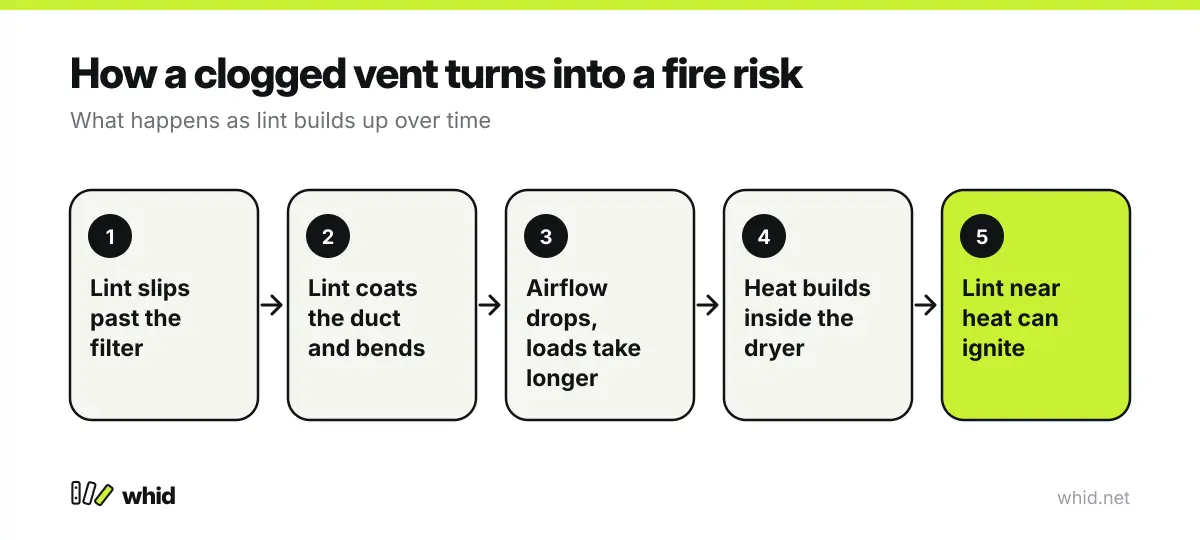
Five-step diagram showing lint passing the filter, clogging the duct, reducing airflow, overheating the dryer and creating a fire risk
Each step is preventable with regular cleaning.

The fire risk is real

Lint is essentially dry, fluffy fuel. According to the US Fire Administration, an estimated 2,900 home clothes dryer fires are reported each year, causing deaths, injuries and around $35 million in property loss, and failure to clean is the leading factor contributing to them. The danger is highest with older white plastic or thin foil ducts, which trap more lint and can melt or burn.

Stop using the dryer if you smell burning, see smoke, or the outside of the machine is too hot to touch. Unplug it (and turn off the gas supply on a gas dryer) and have it checked.

How often to clean — and how

Clean the lint filter before or after every load, and wash it with warm soapy water every few months if you use dryer sheets, which can leave a film that blocks airflow. Clean the entire vent duct at least once a year, and more often for large families, pets or long duct runs.

For a short, accessible duct, a dryer-vent brush kit and a vacuum do the job: unplug the dryer, pull it away from the wall, disconnect the duct, brush and vacuum it from both ends, and clear the outside flap. Long runs through walls or roofs, or ducts with several bends, are best left to a professional dryer-vent cleaner.

Upgrade the duct if you can

Safety agencies recommend rigid or semi-rigid metal ducts that are as short and straight as possible. If yours is white plastic or a crumpled foil hose, replacing it is a cheap upgrade that reduces both clogs and fire risk.


02 Warning signs your vent is clogged

If you notice two or more of these, clean the vent before your next load.

SignWhat it meansUrgency
Clothes need two cycles to dryMoist air isn't leaving the drumMedium
Dryer and clothes feel very hotHeat is trapped inside the machineHigh
Burning smell during a cycleLint may be scorching near the heaterStop using it now
Outside vent flap barely opensLittle or no airflow reaches the outsideMedium
Lint around the outside vent or behind the dryerDuct is overloaded or disconnectedMedium

03 What to do right now

  1. Clean the lint filter every single load. It takes ten seconds and improves airflow immediately.
  2. Check the outside vent flap. Run the dryer and make sure the flap opens and air flows out strongly.
  3. Clean the whole duct at least once a year. Use a brush kit for short ducts or hire a professional for long runs.
  4. Replace plastic or foil ducts with rigid metal. Keep the run short and avoid kinks and sags.
  5. Don't run the dryer when you're asleep or away. That way you can react quickly to smoke or a burning smell.

04 Myth vs fact

Myth Cleaning the lint screen is enough.

Fact Some lint always gets past the screen and collects in the duct, which needs its own cleaning.

Myth Only old dryers catch fire.

Fact Any dryer with a clogged or crushed vent can overheat — the duct matters as much as the machine.

05 Has this happened to you?

Real experiences from readers. Stories are checked by an editor before they appear and are not professional advice.

No reader stories yet — be the first to share yours.

Share what happened to you

By sending, you agree that we may publish your story (first name and location only). See our privacy policy.

06 Quick questions

How often should I clean my dryer vent?

At least once a year, and more often if you dry a lot of loads, have pets, or notice longer drying times.

How much does professional dryer vent cleaning cost?

It varies by region and duct length, but many homeowners pay roughly $100–$200 for a standard job.

Can a clogged dryer vent cause carbon monoxide problems?

With a gas dryer, a blocked vent can push exhaust gases back into the home. Make sure the vent is clear and install a carbon monoxide alarm.

Sources

  1. U.S. Fire Administration — Clothes dryer fire safety outreach materials
  2. National Fire Protection Association — Clothes dryer safety tips
  3. U.S. Consumer Product Safety Commission — Overheated clothes dryers can cause fires

General information only. Laws, prices and procedures vary by location and change over time — check with a qualified professional for your situation. Full disclaimer.