whid

What happens if you put metal in a microwave?

Metal in a microwave doesn't explode — but thin, crumpled or pointed metal can spark, scorch the oven and start a fire. Here's what decides whether you get a light show or nothing at all.

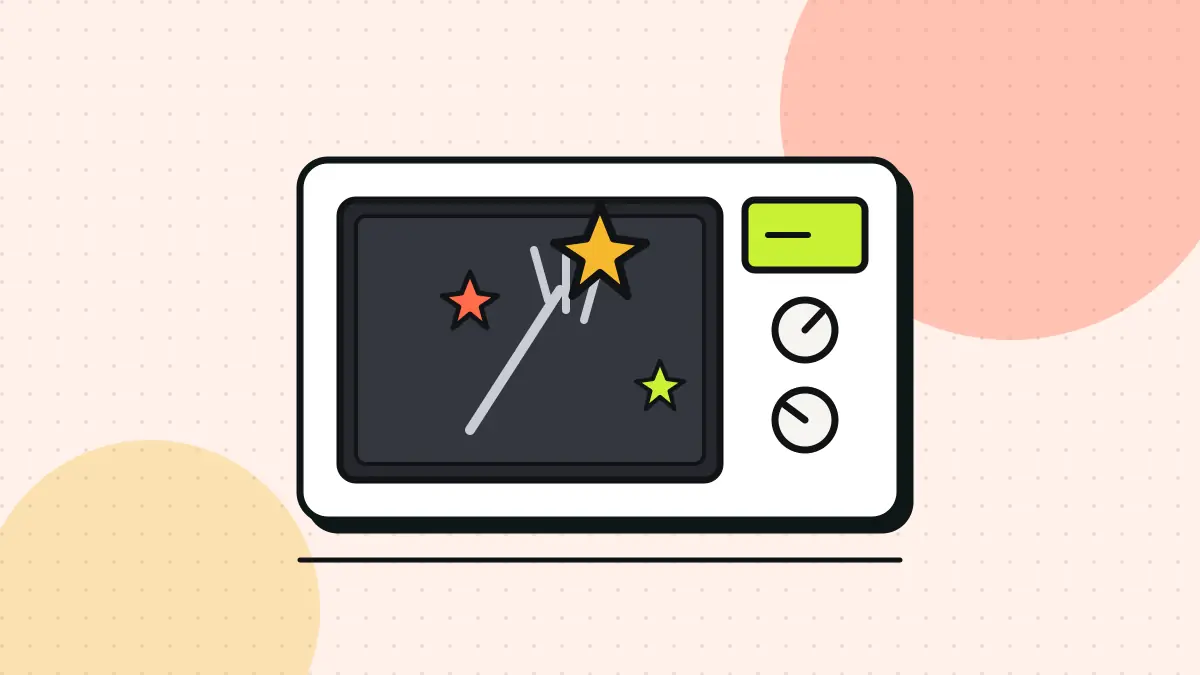
Illustration of a microwave with sparks flying from a fork inside
Illustration: whid
Damage scale 2/5 Annoying
How fastSparks within seconds
Can you undo it?Usually — stop it quickly
Typical cost$0 – a new microwave

The short answer

It depends on the shape of the metal more than the metal itself. Microwaves bounce off metal; thin edges and points — crumpled foil, fork tines, gold trim on a plate — concentrate the energy and cause sparks (arcing) that can burn the oven's interior or set food and paper alight. Smooth, thick metal often just sits there. If you see sparks, stop the microwave immediately.

On this page 9 sections
  1. Step by step
  2. Why metal sparks — and why some metal doesn't
  3. What can actually be damaged
  4. Is the microwave still safe to use?
  5. Which metal objects are the problem?
  6. What to do now
  7. Myth vs fact
  8. Reader stories
  9. Quick questions

01 What happens, step by step

  1. 0–3 sec

    Microwaves hit the metal

    Metal doesn't absorb microwaves the way food does — it reflects them and builds up electric charge, especially on sharp edges.

  2. 3–10 sec

    Sparks and crackling

    Where the charge is concentrated, it jumps through the air as visible blue-white sparks with a crackling or popping sound.

  3. 10–30 sec

    Scorch marks and smoke

    Sparks can scorch the oven's paint or the soft "waveguide cover" on the inside wall, and ignite paper, grease or dry food.

  4. 30+ sec

    Possible fire and damage

    A fire can start inside the oven. Repeated arcing can damage parts that make the microwaves — sometimes ending the appliance's life.

Almost everyone has done it once: a fork left in a bowl of leftovers, a foil-wrapped burrito, grandma's plate with the gold rim. Within seconds the microwave starts to crackle and flash. It looks dramatic, but what happens next depends on how fast you react.

Why metal sparks — and why some metal doesn't

A microwave heats food by making water molecules move. Metal behaves differently: it reflects microwaves and the electric field pushes charges around on its surface. On a smooth, rounded object the charge spreads out. On a sharp point or a thin edge, it piles up — until it is strong enough to jump through the air as a spark. That is why a crumpled sheet of foil, with hundreds of tiny edges, is far worse than a smooth piece.
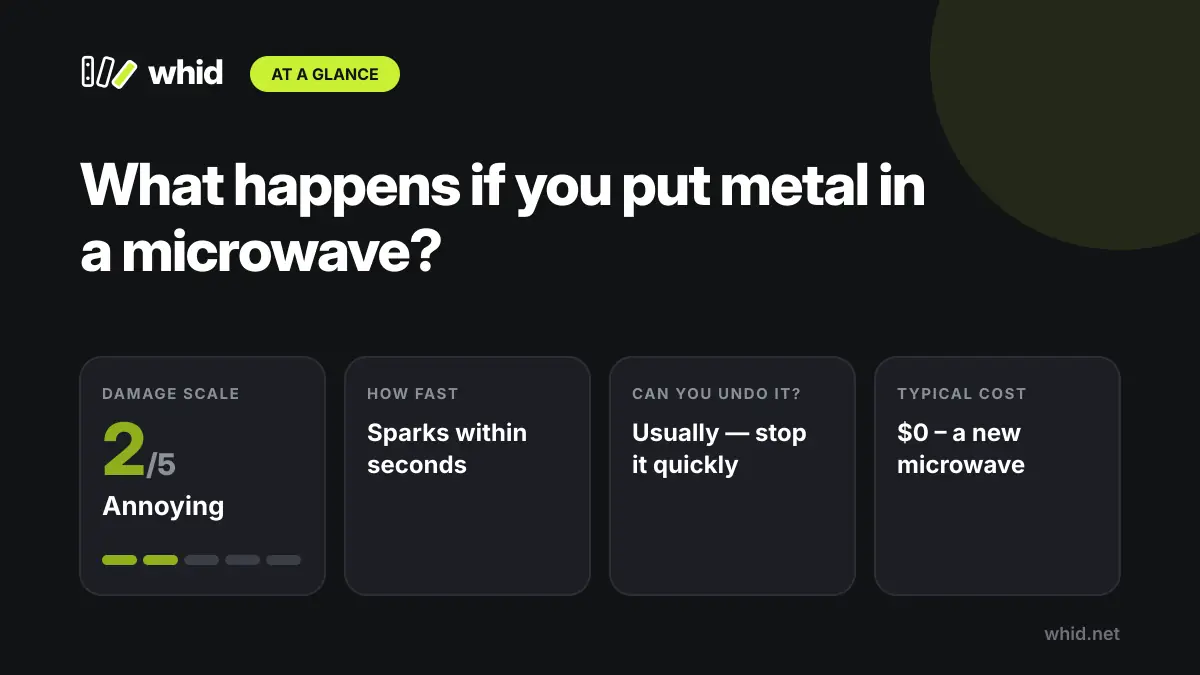
At a glance: What happens if you put metal in a microwave? Damage scale 2/5 (Annoying); how fast: Sparks within seconds; typical cost: $0 – a new microwave.
At a glance: the damage rating, how fast it happens, whether it can be undone and what it usually costs.

It's also why many microwaves ship with a metal rack, and why some manufacturers allow small, flat pieces of foil to shield parts of food from overcooking. The rules are specific to each model, so the manual is the authority here.

What can actually be damaged

  • The waveguide cover — a small panel, usually made of mica, on the inside wall. Sparks can burn holes in it. It's a cheap part, but if it's damaged the oven can arc again even without metal.
  • The interior coating — burned paint can expose metal that rusts and sparks later.
  • The food, packaging and you — the most serious risk is fire, especially with paper bags, takeout containers or greasy food.
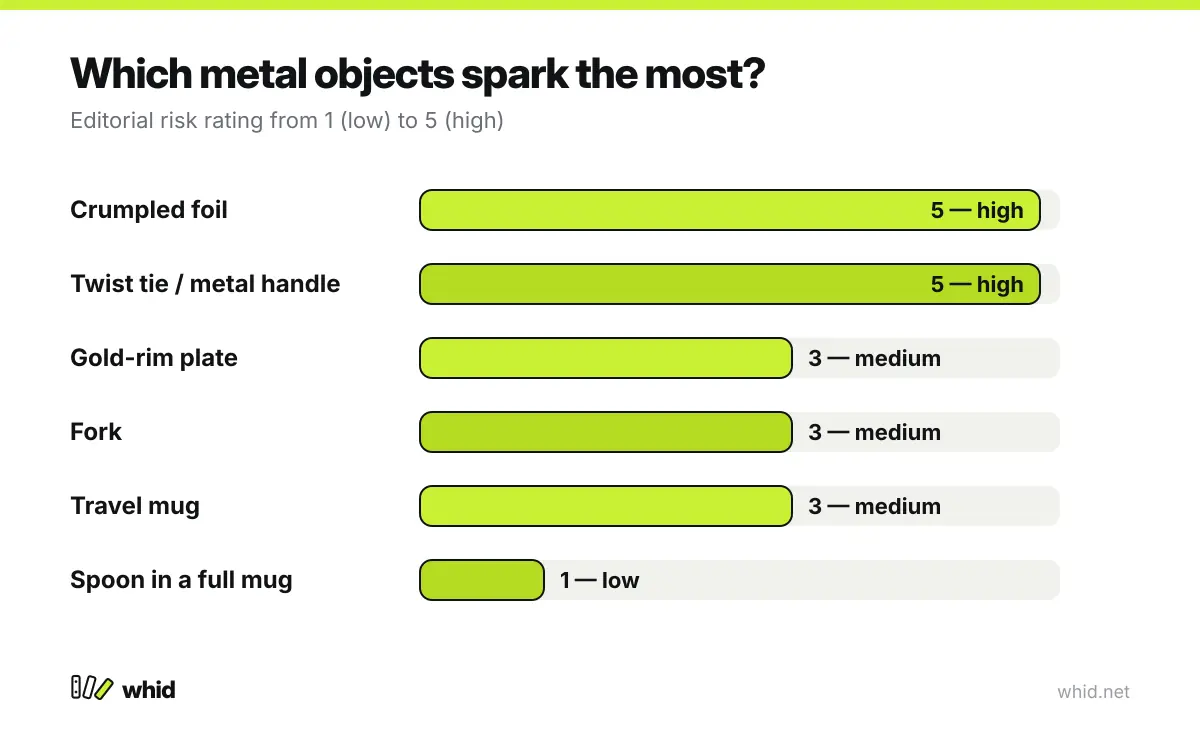
If there are flames: keep the door closed, switch the microwave off and unplug it if you can reach the plug safely. Without fresh oxygen, a small fire inside usually goes out. If it doesn't, leave and call the fire service.
Bar chart rating the sparking risk of metal objects in a microwave, from crumpled foil (high) to a spoon in a mug of liquid (low)
Thin edges and points are what cause sparks — not metal as such.

Is the microwave still safe to use?

After a short spark with no visible damage, most microwaves are fine. Let it cool, wipe it out and check the inside walls and the waveguide cover for black marks or holes. Then heat a cup of water for one minute. If the water gets hot, there are no sparks and no burning smell, you can carry on. If you see burn marks inside, the oven keeps sparking or the door no longer closes properly, stop using it and have it checked or replaced.

02 Which metal objects are the problem?

Always follow your microwave's manual — some models allow small pieces of foil or the metal rack that came with the oven.

ObjectWhat usually happensRisk
Crumpled aluminium foilLots of sparks along the folds and edges; can igniteHigh
ForkSparks between the tinesMedium
Plate or mug with gold/silver trimArcing along the rim; the trim gets burned offMedium
Twist tie or takeout box with metal handleSparks at the wire; paper or plastic can catch fireHigh
Stainless steel travel mugContents don't heat; possible arcing; mug can be damagedMedium
Spoon left in a full mug of liquidOften no sparks, but heating is uneven — not recommendedLow
Small, smooth foil pieces used as shielding (if your manual allows)Usually no sparks when kept away from the wallsLow

03 What to do right now

  1. Stop the microwave right away. Press stop or open the door — unless there are flames inside.
  2. If there's fire, keep the door shut. Turn it off and unplug it if safe. Call the fire service if the flames don't die down quickly.
  3. Let it cool, then inspect. Look for scorch marks, holes in the waveguide cover and melted packaging.
  4. Do the water test. Heat a microwave-safe cup of water for 60 seconds: hot water, no sparks, no smell = usually OK.
  5. Replace a burned waveguide cover. It's an inexpensive part; a damaged one can cause sparking even without metal.

04 Myth vs fact

Myth Any metal in a microwave will explode.

Fact Metal doesn't explode. Thin and pointed metal can spark; smooth, thick metal often doesn't.

Myth Sparks make the microwave leak radiation.

Fact Leakage depends mainly on the door, hinges and seals. Sparks are a fire and damage risk — but a damaged door is what you should worry about for leakage.

05 Has this happened to you?

Real experiences from readers. Stories are checked by an editor before they appear and are not professional advice.

No reader stories yet — be the first to share yours.

Share what happened to you

By sending, you agree that we may publish your story (first name and location only). See our privacy policy.

06 Quick questions

Can I microwave food in aluminium foil?

Not wrapped in it. Some manuals allow small, smooth pieces of foil to shield parts of food, kept away from the walls. Check your model's instructions.

What happens if I accidentally microwaved a fork for a few seconds?

Usually nothing lasting. Remove it, check for black marks on the walls and run the water test.

Is food heated with a spark safe to eat?

If the food isn't burned and no packaging melted onto it, it's generally fine. Throw it away if plastic or paper burned into it.

Sources

  1. U.S. Food and Drug Administration — Microwave oven radiation
  2. USDA Food Safety and Inspection Service — Cooking safely in the microwave oven
  3. Your microwave's user manual (foil and rack instructions)

General information only. Laws, prices and procedures vary by location and change over time — check with a qualified professional for your situation. Full disclaimer.