whid

What happens if you don't use your Google account for 2 years?

What happens if you don't use your Google account for 2 years? Google may delete it, including Gmail, Drive and Photos. Here's how to keep it.

Flat illustration of a laptop showing an email envelope with a red X badge next to an hourglass, suggesting an unused email account running out of time.
Illustration: whid
Damage scale 3/5 Costly
How fastNothing for 2 years, then warnings for months
Can you undo it?Yes before deletion — just sign in
Typical costFree to fix; deleted mail and photos are gone

The short answer

A personal Google account that hasn't been used or signed into for at least two years can be deleted under Google's inactive account policy, along with its Gmail, Drive, Docs, Calendar and Photos content. Google says it sends several warning emails over the months before deletion, to the account and to its recovery address. Signing in and using almost any Google service resets the clock, and work or school accounts are not covered.

On this page 11 sections
  1. Step by step
  2. What counts as "using" your account
  3. What actually gets deleted
  4. The warnings come first
  5. Planning ahead with Inactive Account Manager
  6. Accounts this does not apply to
  7. Will your account be deleted?
  8. What to do now
  9. Myth vs fact
  10. Reader stories
  11. Quick questions

01 What happens, step by step

  1. Last sign-in

    The clock starts

    Google tracks activity across its services. Any sign-in and use resets the two-year count.

  2. Up to 18 months

    Your own plan can kick in

    If you set up Inactive Account Manager, your chosen contacts, auto-reply or deletion follow the timeout you picked.

  3. Months before deletion

    Warning emails

    Google sends multiple notices to the account and to the recovery email, if one exists.

  4. 2+ years

    Eligible for deletion

    The account and its Gmail, Drive, Docs, Calendar and Photos content can be removed.

  5. After deletion

    Address retired

    The data is gone and the Gmail username can't be reused, so linked services may lose contact.

Most people have at least one Google account they've forgotten about: the Gmail address from college, the account you made for an old Android phone, the one tied to a YouTube channel you never posted on. For years, those accounts just sat there. That changed in 2023, when Google announced it would start removing personal accounts that go unused for a long time.

The rule is simple on paper. If a personal Google account shows no activity across Google for at least two years, Google reserves the right to delete the account and everything stored in it. Google said the earliest deletions under the policy would happen in December 2023, starting with accounts that were created and then never used again.
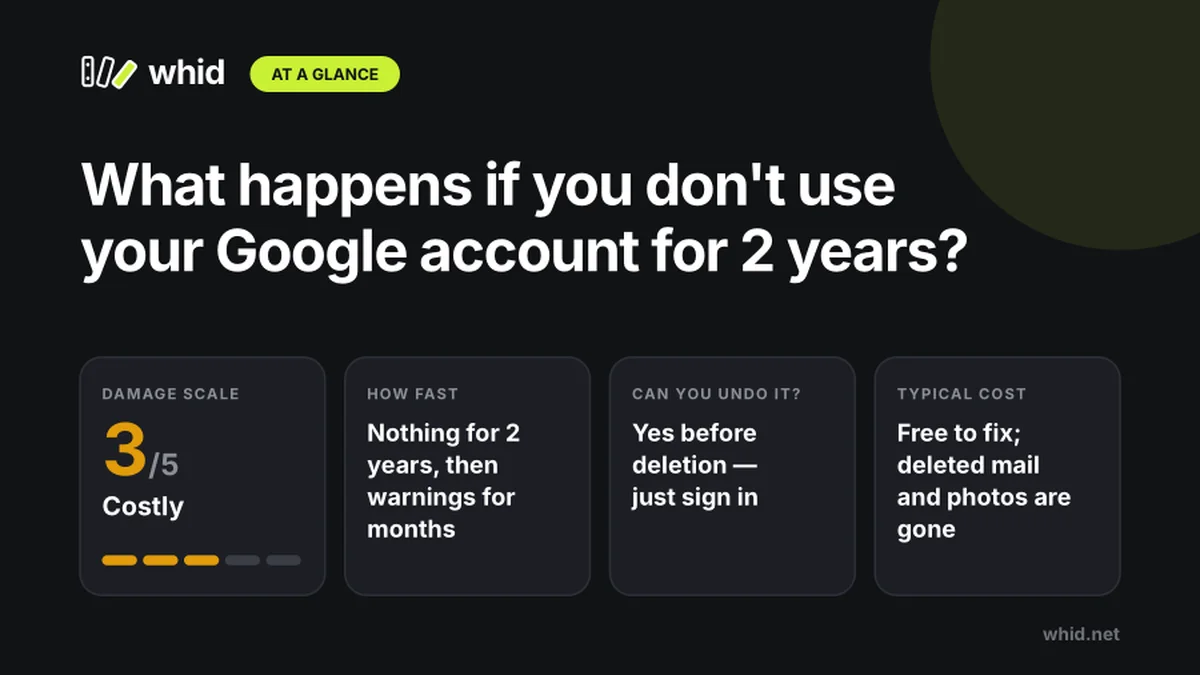
At a glance: What happens if you don't use your Google account for 2 years? Damage scale 3/5 (Costly); how fast: Nothing for 2 years, then warnings for months; typical cost: Free to fix; deleted mail and photos are gone.
At a glance: the damage rating, how fast it happens, whether it can be undone and what it usually costs.

What counts as "using" your account

The bar is low. Google's help page lists actions such as reading or sending an email, using Google Drive, watching a YouTube video, sharing a photo, downloading an app from Google Play, running a Google Search while signed in, and using "Sign in with Google" to log into another app or website. Activity is tracked per account, so if you have three accounts on one phone, each needs its own use.

A few things also protect an account even without regular logins. Google lists an active subscription or ongoing purchase made through the account, a gift card balance, a published app with active financial transactions, managing a child's account through Family Link, and owning a purchased digital item such as a movie or book.

Quick check: If you're not sure whether an old address still works, try signing in now. A successful login with a quick look at Gmail is generally enough to count as activity.

What actually gets deleted

When an account is removed under this policy, its contents go with it. Google specifically names Gmail, Docs, Drive, Meet, Calendar and Google Photos. Individual products can also have their own inactivity rules, so data in a single service you never open can be at risk even if the account itself survives.

YouTube is the notable exception for now. Google has said it has no plans to delete accounts that have YouTube videos on them. That's a statement of current plans, not a permanent promise, so creators with old channels shouldn't count on it forever.

The loss that surprises people most is the email address itself. Google's help pages say that once an account is deleted, you can't reuse that Gmail username. Anything linked to that address, from bank alerts to password resets for other sites, can be cut off.
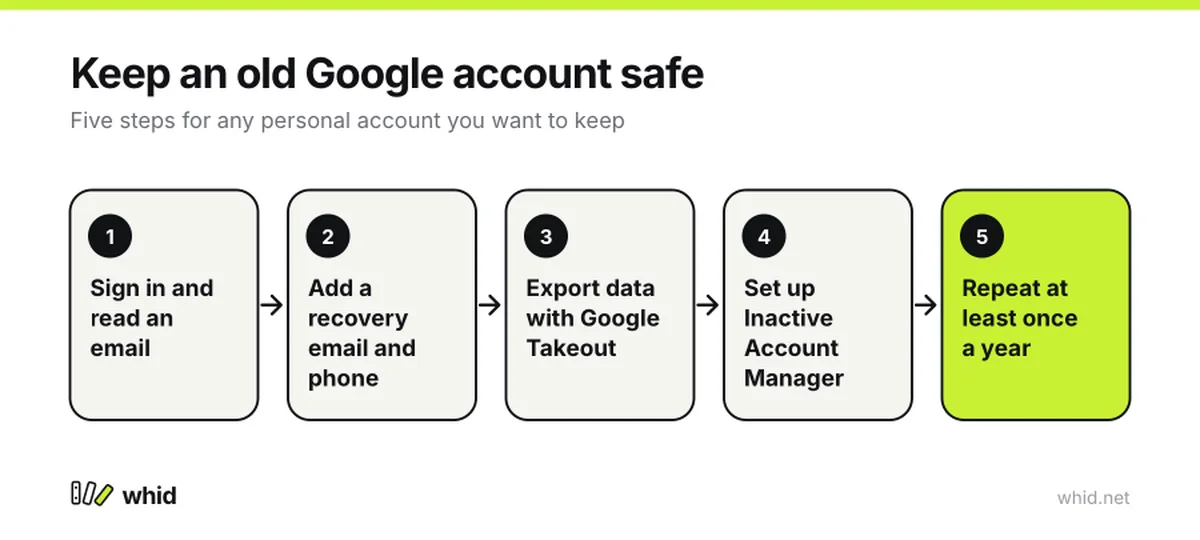
Five-step graphic: sign in and read an email, add a recovery email and phone, export data with Google Takeout, set up Inactive Account Manager, repeat at least once a year.
A quick routine that keeps a rarely used Google account from reaching the two-year inactivity mark.

The warnings come first

Deletion is not supposed to happen without notice. Google says it sends multiple notifications in the months leading up to deletion, both to the inactive account and to its recovery email, if one was set. The weak point is obvious: if you never check the old inbox and never added a recovery address, those warnings may land where nobody reads them.

Don't wait for the email: If the old account holds family photos or important records, sign in and download a copy with Google Takeout instead of relying on a warning you might miss.

Planning ahead with Inactive Account Manager

Google offers a free tool called Inactive Account Manager at myaccount.google.com/inactive. You choose how long Google should wait before treating your account as inactive (Google's announcement describes periods of up to 18 months), and what happens next. You can notify up to 10 trusted people, share selected data with them through a download link, set an automatic Gmail reply, or have the account deleted entirely.

Accounts this does not apply to

The policy covers personal accounts only. Accounts issued by an employer, a school or another organization follow that organization's own rules, so ask your IT department or school administrator how long they keep accounts after you leave.
02 Will your account be deleted?

Based on Google's published inactive account policy for personal accounts. Google can update its policies.

SituationAt risk?What to do
No sign-in or activity for 2+ yearsYesSign in now and use any Google service
Rarely used, but signed in on your phoneUsually notOpen Gmail or another app on that account now and then
Inactive, but has an active subscription or gift card balanceNo, per Google's exceptionsKeep the subscription current
Inactive, but has YouTube videosNot currently plannedStill sign in periodically to be safe
Work or school accountNot under this policyCheck your organization's own rules

03 What to do right now

  1. Sign in to every old account you still want. Log in, read an email or run a search. That counts as activity and resets the two-year clock.
  2. Add or update a recovery email and phone. Warnings also go to your recovery address, and it helps you get back in if you forget the password.
  3. Download what matters with Google Takeout. Export Gmail, Photos and Drive files so a copy exists outside the account.
  4. Set up Inactive Account Manager. Choose a timeout and pick trusted contacts who get notified or receive your data.
  5. Move important logins to an address you use. Update banks, utilities and other sites that still send codes or resets to the old Gmail.

04 Myth vs fact

Myth Google deletes accounts without any warning.

Fact Google says it sends several notices in the months before deletion, to the account and to its recovery email.

Myth You have to log in on a computer to keep an account alive.

Fact Activity counts on any device. Reading email in the Gmail app, watching YouTube or searching while signed in all count.

Myth A deleted Gmail address will just go to someone else.

Fact Google says a deleted Gmail username can't be reused, so it is retired rather than reissued.

05 Has this happened to you?

Real experiences from readers. Stories are checked by an editor before they appear and are not professional advice.

No reader stories yet — be the first to share yours.

Share what happened to you

By sending, you agree that we may publish your story (first name and location only). See our privacy policy.

06 Quick questions

How long can a Google account be inactive before it's deleted?

Under Google's policy, a personal account can be deleted after at least two years without being used or signed into. Google began deletions no earlier than December 2023.

Does watching YouTube keep my Google account active?

Yes. Google lists watching a YouTube video while signed in as account activity, along with reading email, using Drive and searching.

Can I recover a Google account after it's deleted for inactivity?

Don't count on it. Google says you might be able to recover a recently deleted account, but after a while the data is permanently gone. Signing in before the deadline is the safe move.

Does this apply to my work or school Google account?

No. The inactive account policy covers personal accounts. Organization accounts follow the organization's own retention rules.

Sources

  1. Google Account Help — Inactive Google Account Policy
  2. Google Blog — Updating our inactive account policies (May 2023)
  3. Google Account Help — About Inactive Account Manager

General information only. Laws, prices and procedures vary by location and change over time — check with a qualified professional for your situation. Full disclaimer.