
whid

What happens if you never change your car's oil?

What happens if you never change your car's oil? Old oil turns to sludge, parts wear faster, and the engine can eventually seize. Here's the full timeline.

Flat illustration of a blue car with a red warning symbol above it, an oil puddle beneath, black oil drops and a yellow oil can with a gauge.
Illustration: whid
Damage scale 4/5 Serious
How fastSlow: damage builds over thousands of miles
Can you undo it?Early on, yes. Sludge and worn bearings, no
Typical costCheap oil change vs. engine repair in the thousands

The short answer

Motor oil wears out. Skip changes long enough and it fills with dirt, soot and metal particles, then thickens into sludge that can clog the engine's oil passages. Parts start rubbing, the engine runs hotter, and in the worst case bearings fail or the engine seizes, which usually means a rebuild or replacement. Neglected maintenance can also put a warranty claim at risk.

On this page 11 sections
  1. Step by step
  2. How oil goes bad
  3. What you might notice first
  4. How an engine actually dies
  5. Warranty and resale
  6. How often you really need to change it
  7. How overdue are you?
  8. What to do now
  9. Myth vs fact
  10. Reader stories
  11. Quick questions

01 What happens, step by step

  1. Past due date

    Protection starts slipping

    The oil is dirtier and thinner on additives, but most engines run normally. This is the cheap moment to fix it.

  2. Thousands of miles late

    Level drops, oil darkens

    Some oil burns off or evaporates. What remains is darker, gritty and doesn't flow as well on cold starts.

  3. Much later

    Sludge and varnish form

    Thickened oil coats internal parts and can start blocking small oil passages.

  4. Warning signs

    Ticking, heat, warning light

    Lifter noise, higher temperatures or an oil pressure light show parts aren't getting enough oil.

  5. End stage

    Bearings fail or engine seizes

    Metal-on-metal contact can spin a bearing or lock the engine, usually requiring a rebuild or replacement.

Engine oil does three jobs at once: it keeps metal parts from grinding against each other, carries heat away from hot spots, and holds dirt in suspension so the filter can catch it. None of that lasts forever. Heat breaks the oil down, and every mile adds a little more soot, dust and microscopic metal.

Miss one oil change by a few hundred miles and you probably won't notice anything. Never change it, and you are slowly trading a routine service for one of the most expensive repairs a car can need.

At a glance: What happens if you never change your car's oil? Damage scale 4/5 (Serious); how fast: Slow: damage builds over thousands of miles; typical cost: Cheap oil change vs. engine repair in the thousands.
At a glance: the damage rating, how fast it happens, whether it can be undone and what it usually costs.

How oil goes bad

Fresh oil is thin enough to reach tight clearances within seconds of a cold start. As it ages, it collects contaminants, and some of it burns off or evaporates. The level drops, and what's left gets darker and thicker. Eventually it turns into a tar-like sludge and leaves varnish on internal parts.

Sludge is the real problem. It can block the small passages that feed oil to the camshafts, timing components and crankshaft bearings. A part that doesn't get oil doesn't get cooled either.

What you might notice first

  • Ticking or tapping from the top of the engine, often valve lifters that aren't getting enough oil pressure.
  • An oil pressure warning light, which means stop driving and check the level now, not at your next service.
  • Worse fuel economy and an engine that runs hotter than usual.
  • Dark, gritty oil on the dipstick, or a level well below the minimum mark.
Red light means stop: a red oil pressure warning is not a reminder to book a service. Pull over safely and shut the engine off. Driving on with little or no oil pressure can destroy an engine in a short time.
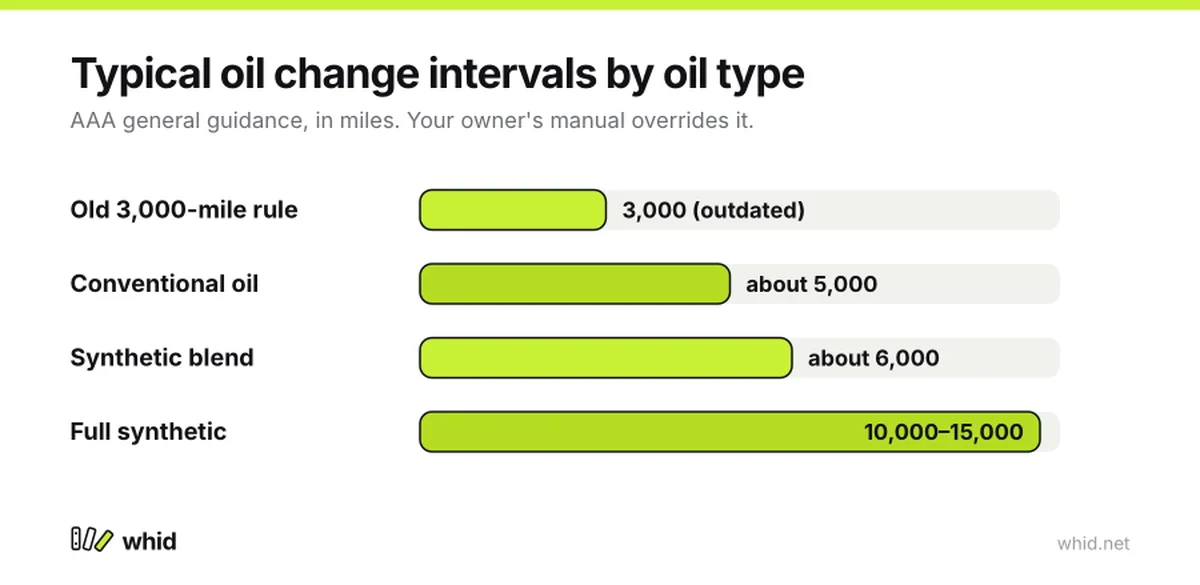
Bar chart comparing typical oil change intervals: the outdated 3,000-mile rule, about 5,000 miles for conventional oil, about 6,000 for synthetic blend, and 10,000 to 15,000 for full synthetic.
Intervals vary by engine and driving conditions, so treat these as rough ranges and follow your manual.

How an engine actually dies

The usual end point is bearing failure. Crankshaft and connecting rod bearings ride on a thin film of oil. Starve them, and metal touches metal, heat spikes, and a bearing can spin or weld itself to the crankshaft. At that point the fix is a rebuild or a replacement engine, which typically costs far more than years of oil changes.

One trap catches owners who try to catch up: a heavily sludged engine can react badly to an aggressive engine-flush additive. Loosened chunks of sludge can travel and block oil passages. If an engine has gone a very long time without service, ask a mechanic before pouring in a flush.

Warranty and resale

The Federal Trade Commission advises keeping receipts for all routine maintenance, including oil changes, no matter who does the work. If a warranty claim comes up and it looks like the car wasn't maintained, the claim may be denied. You don't have to use the dealer, though: a dealer can't deny warranty coverage just because routine maintenance was done somewhere else. A thin service history also makes a used car harder to sell.

How often you really need to change it

The old every-3,000-miles rule is outdated for most modern cars. AAA's general guidance is roughly every 5,000 to 7,500 miles for most engines, with longer intervals for full synthetic oil. Your owner's manual is the final word, and many cars now have an oil-life monitor that tells you when it's due.

Two exceptions matter. Short trips, stop-and-go traffic, extreme heat or cold, and towing count as severe service, which usually means a shorter interval. And oil ages even if you barely drive, so a low-mileage car still needs a change at least once a year in many cases.

02 How overdue are you?

General guidance. Your owner's manual and oil-life monitor take priority.

SituationLikely engine conditionWhat to do
A few hundred miles past dueUsually fineBook a normal oil change soon
One full interval skippedDirty oil, faster wearChange oil and filter now; check the level
Oil level below the dipstick minimumParts may be under-lubricatedTop up to the mark, then get a change
Ticking noise or oil pressure lightOil starvation possibleStop driving and have it inspected
Years with no oil changesSludge likelyAsk a mechanic before any engine flush

03 What to do right now

  1. Check the dipstick today. With the engine off on level ground, pull the dipstick, wipe it, reinsert it and read the level. Low or very dark, gritty oil means it's overdue.
  2. Find your real interval. Look up the schedule in your owner's manual, including the severe-service schedule if you mostly make short trips, sit in traffic or tow.
  3. Stop if the oil light turns red. Pull over safely and turn the engine off. Add the correct oil if you have it, and get the car checked before driving far.
  4. Keep every receipt. Save oil change records from any shop or your own DIY parts purchases. They help with warranty claims and resale.
  5. Use the oil grade your manual lists. The wrong viscosity can reduce fuel economy and protection. The grade is printed in the manual and often on the oil filler cap.

04 Myth vs fact

Myth You must change oil every 3,000 miles.

Fact Most modern engines go longer. AAA cites roughly 5,000 to 7,500 miles for most engines, and your manual sets the actual schedule.

Myth If the car isn't driven much, the oil never needs changing.

Fact Oil degrades over time too. Low-mileage cars generally still need a change at least once a year or as the manual specifies.

Myth Getting oil changed outside the dealer voids your warranty.

Fact The FTC says a dealer can't deny coverage simply because routine maintenance was done elsewhere. Keep the receipts.

05 Has this happened to you?

Real experiences from readers. Stories are checked by an editor before they appear and are not professional advice.

No reader stories yet — be the first to share yours.

Share what happened to you

By sending, you agree that we may publish your story (first name and location only). See our privacy policy.

06 Quick questions

How long can a car go without an oil change?

It depends on the engine, the oil and how you drive. Many engines tolerate going a bit past the interval, but there's no safe number for skipping changes entirely. Follow the manual or oil-life monitor.

Is topping off the oil the same as changing it?

No. Topping off restores the level, but the old oil still carries dirt and worn-out additives, and the filter stays clogged. It's a stopgap until a real change.

Can sludge be cleaned out?

Sometimes, partly. A mechanic may recommend several short-interval oil changes or a careful cleaning. Heavy sludge can require taking parts off the engine.

Does a skipped oil change automatically void my warranty?

Not automatically, but if an engine failure looks related to neglected maintenance, the claim may be denied. Service records are your best protection.

Sources

  1. AAA: How Often Should You Change Your Oil?
  2. FTC: Auto Warranties and Service Contracts
  3. FTC: Auto Repair Basics
  4. FuelEconomy.gov: Keeping Your Vehicle in Shape

General information only. Laws, prices and procedures vary by location and change over time — check with a qualified professional for your situation. Full disclaimer.