whid

What happens if you put a soda can in the freezer?

Freezing water expands, carbon dioxide gets squeezed out and the can gives way. The physics, how long you have, what to do with a bulging can and faster safe ways to chill a drink.

Illustration of a soda can with a snowflake beside it
Illustration: whid
Damage scale 2/5 Annoying
How fast1–3 hours
Can you undo it?No, but cleanable
Typical costA sticky freezer

The short answer

Forget it for an hour or two and the can will likely bulge, leak or burst. Water expands about 9% when it freezes, and as ice forms it pushes dissolved carbon dioxide out of the drink into a shrinking pocket of gas. Pressure rises until the lid, seam or tab gives way, coating the freezer in sticky slush. A frozen, bulging can can also burst when you handle it, so let it thaw in a bowl in the fridge before opening.

On this page 12 sections
  1. Step by step
  2. Water grows when it freezes
  3. The carbon dioxide makes it worse
  4. How long you have
  5. What about beer, sparkling water and juice?
  6. If you find a frozen or bulging can
  7. Faster, safer ways to chill a drink
  8. Ways to chill a drink fast
  9. What to do now
  10. Myth vs fact
  11. Reader stories
  12. Quick questions

01 What happens, step by step

  1. 0–20 min

    Pleasantly cold

    The drink cools quickly. This is the moment to take it out.

  2. 45–90 min

    Ice starts forming

    Crystals push carbon dioxide out of the liquid.

  3. 1–3 hours

    Bulge and burst

    Pressure from expanding ice and trapped gas splits the lid or seam.

  4. Next day

    Sticky cleanup

    Frozen sugary slush coats the shelf and anything nearby.

It is the oldest kitchen shortcut there is: the drinks are warm, guests are arriving, so a few cans go in the freezer for twenty minutes. Then someone opens the freezer the next morning to find a brown, sticky, frozen mess and a can split open like a flower. Why does a sealed can, which survives being dropped and shaken, fail so badly in the cold?

Water grows when it freezes

Most substances shrink as they cool. Water is the odd one out. As it turns to ice, its molecules lock into an open crystal structure that takes up roughly 9% more space than the liquid did. That is why ice floats and why water pipes burst in winter.
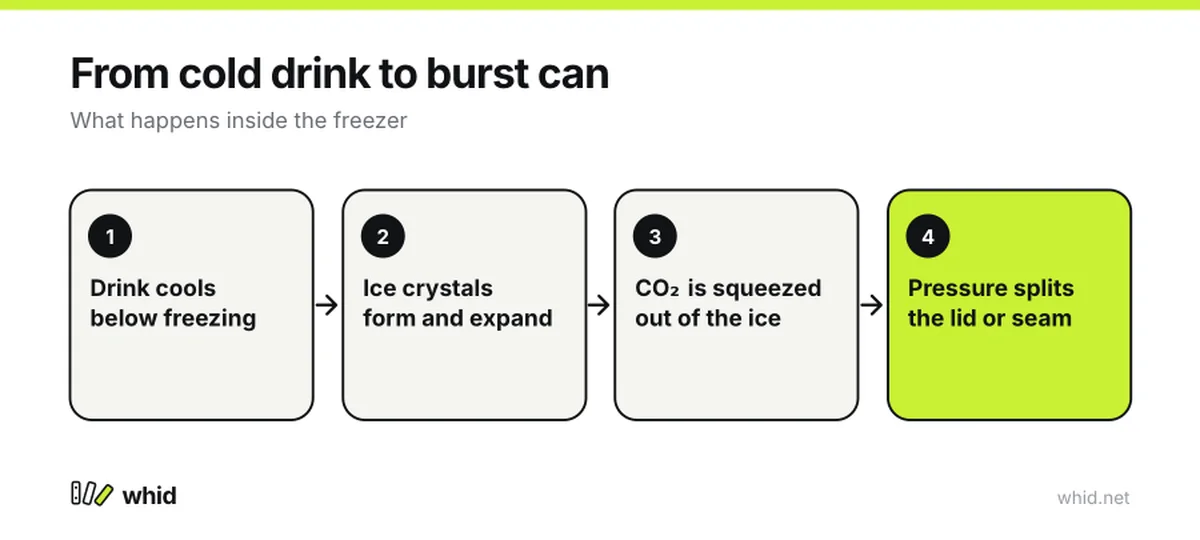
Four steps from a cold soda to a burst can: cooling, ice expansion, carbon dioxide pushed out, the lid or seam failing
The trapped gas is what makes bursts violent.
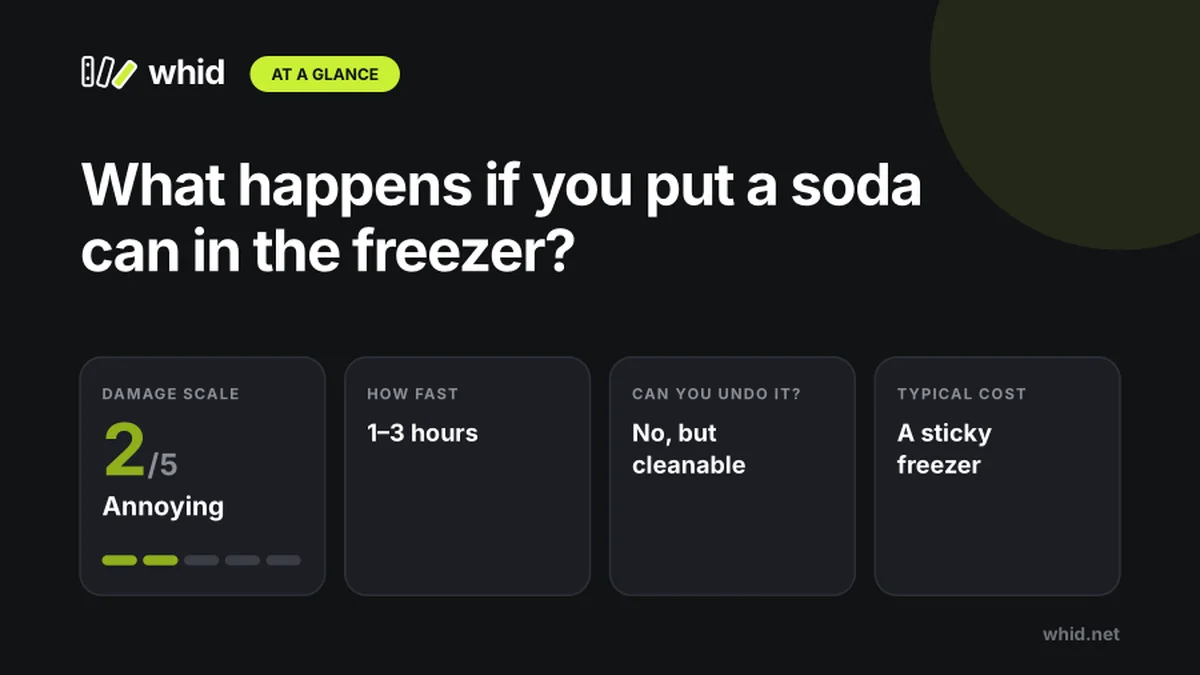
At a glance: What happens if you put a soda can in the freezer? Damage scale 2/5 (Annoying); how fast: 1–3 hours; typical cost: A sticky freezer.
At a glance: the damage rating, how fast it happens, whether it can be undone and what it usually costs.

A soda is mostly water. A standard 12-ounce can holds 355 milliliters of drink; frozen solid, that much water would want around 387 milliliters of room. Cans are filled with only a small gap at the top, so the ice has nowhere to go except outward.

The carbon dioxide makes it worse

Expansion alone would bulge the can. What makes cans fail more violently is the fizz. Soda is carbonated by dissolving carbon dioxide into it under pressure. Cold liquid can actually hold more gas than warm liquid, but ice holds almost none. As ice crystals form, they push the dissolved carbon dioxide out of the solution and into the small space that is left.

University of Virginia physicist Louis Bloomfield has explained that the gas is the dangerous part: once it is forced out of the freezing water, the pressure in the remaining space rises sharply. The can's weakest points, the seam at the top, the scored opening and the tab, give way first. Sometimes it is a slow leak. Sometimes it is a pop loud enough to hear from the next room.
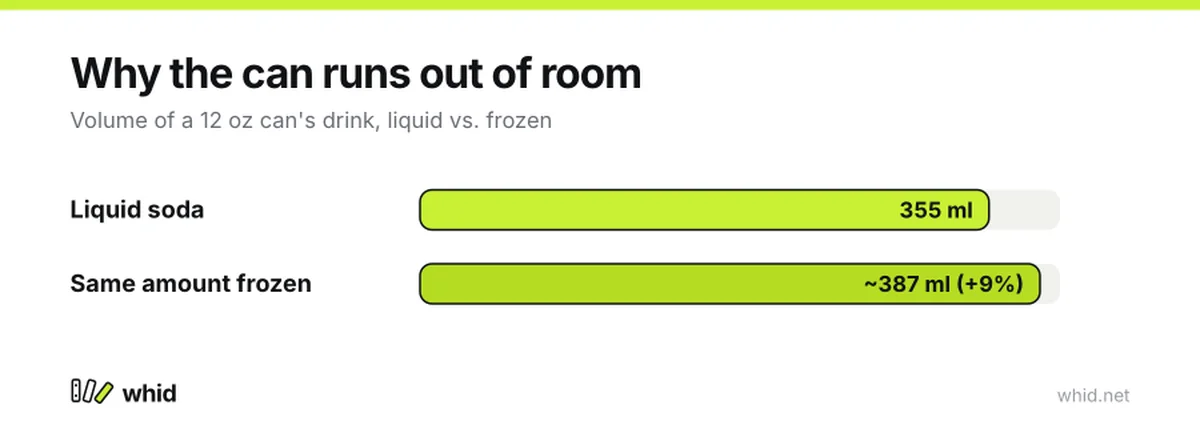
Bar chart: 355 ml of liquid soda becomes about 387 ml when frozen, a 9% increase
Our calculation using water's roughly 9% expansion on freezing.

How long you have

Soda does not freeze at exactly 32°F. The sugar and dissolved gas lower its freezing point slightly, to somewhere around 28°F to 30°F, so it takes a little longer than plain water. In a typical home freezer set near 0°F, a can is pleasantly cold in 15 to 20 minutes and starts forming ice somewhere after about 45 minutes. Bursts usually happen after an hour or two, depending on the freezer, the can's starting temperature and how crowded the shelf is.

Glass bottles are more dangerous than cans because they shatter into sharp pieces. Plastic bottles flex and usually survive longer, but a frozen bottle can still split.

What about beer, sparkling water and juice?

Beer and hard seltzer behave much like soda because they are carbonated and mostly water. Alcohol lowers the freezing point a little, so they may last slightly longer, but cans and bottles will still burst once ice forms. Plain sparkling water often fails fastest of all, because there is no sugar to lower its freezing point.

Non-carbonated drinks in cartons or plastic bottles usually just bulge, since there is no gas to build extra pressure, and many juices are sold frozen for exactly that reason. Wine bottles are a different risk: freezing wine can push the cork out partway or crack the glass, and the wine's flavor may change after thawing. In short, if it is sealed, mostly water and especially if it is fizzy, keep it out of the freezer for anything longer than a quick chill.

If you find a frozen or bulging can

Treat it as a pressurized object. Do not open it, shake it or squeeze it, and keep it pointed away from your face. A frozen can can still burst while you are holding it, and there have been injuries from cans that exploded in someone's hand. Put it in a bowl or deep container and let it thaw slowly in the refrigerator. Once it has fully thawed, open it over the sink. The drink will be flat and is best poured away.

If a can has already burst, wear gloves to remove any sharp pieces of metal, then lift out the frozen slush. Warm, soapy water cuts through dried sugar much better than cold. Wipe down drawers and shelves before the sticky residue gets a chance to glue frozen food to them.
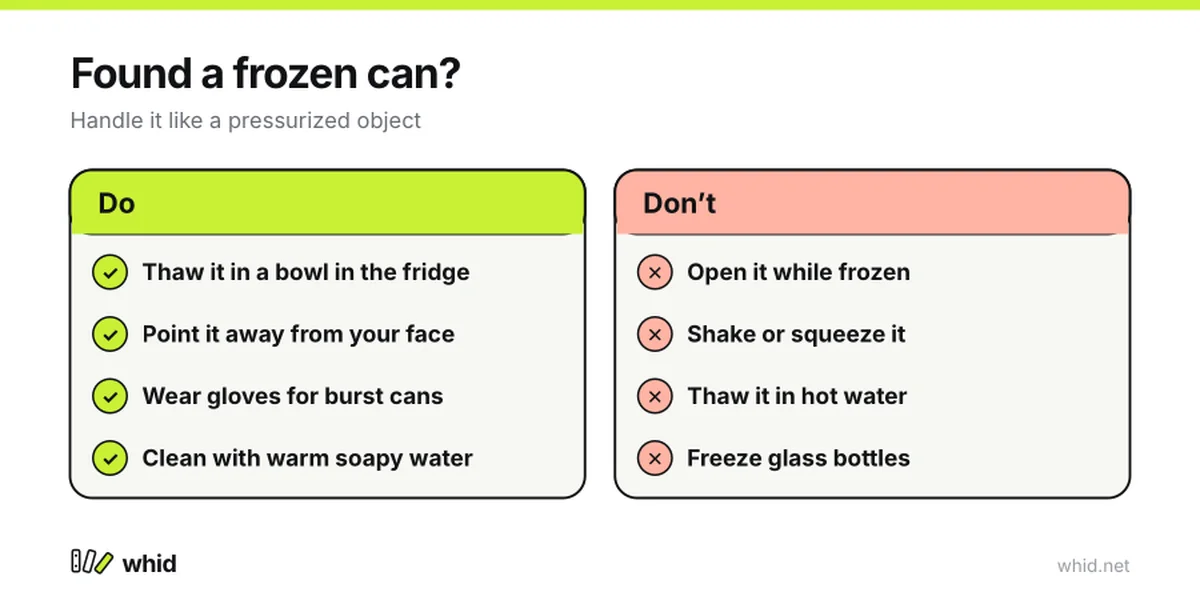
Do and don't list for handling a frozen soda can
Slow thawing is the safe way.

Faster, safer ways to chill a drink

If you do use the freezer, set a timer on your phone for 20 minutes. Wrapping each can in a wet paper towel before putting it in speeds things up because the evaporating water pulls heat away.

The quickest method skips the freezer entirely. Fill a bowl with ice and water, stir in a generous handful of salt, and submerge the cans. Salt lowers the freezing point of the water so the bath gets colder than ice alone, and liquid water touches the whole can, which transfers heat far better than air. Turning the cans now and then speeds it up further, and a few minutes is usually enough for a cold drink.

And if you want a slushy texture on purpose, freeze soda in an open container with plenty of headspace, like an ice cube tray. Without a sealed lid, the gas simply escapes and nothing bursts.


02 Ways to chill a drink fast

Times are rough and depend on your freezer and starting temperature.

MethodSpeedRiskTip
Freezer, can as isAbout 20 min to coldBursts if forgottenSet a timer
Freezer, wet paper towelFasterSameWrap each can
Ice water and salt bathFastest, a few minutesNoneStir or turn the cans
RefrigeratorHoursNonePlan ahead

03 What to do right now

  1. Set a timer If a can goes in the freezer, a 20-minute alarm prevents the mess.
  2. Never open a bulging can Thaw it in a bowl in the fridge, pointed away from you.
  3. Use an ice and salt bath It chills cans faster than the freezer with no risk of bursting.
  4. Clean with warm soapy water Dried soda sugar dissolves far better in warm water.

04 Myth vs fact

Myth Only the ice expanding makes cans burst.

Fact Carbon dioxide forced out of the freezing drink adds a lot of pressure.

Myth Diet soda will not explode.

Fact It is still mostly carbonated water and behaves the same way.

Myth A frozen can is safe once it is out of the freezer.

Fact A bulging can can still burst while you handle it.

05 Has this happened to you?

Real experiences from readers. Stories are checked by an editor before they appear and are not professional advice.

No reader stories yet — be the first to share yours.

Share what happened to you

By sending, you agree that we may publish your story (first name and location only). See our privacy policy.

06 Quick questions

How long can a soda can stay in the freezer?

About 20 minutes for a cold drink. Ice usually starts forming after roughly 45 minutes, and bursts commonly happen within one to three hours.

Why do soda cans explode in the freezer?

Water expands about 9% as it freezes, and carbon dioxide pushed out of the ice builds pressure until the can gives way.

Can I drink soda that froze?

If the can is intact, thaw it in the fridge. It will be flatter than before.

What is the fastest way to chill a can?

An ice water bath with salt, turning the can occasionally.

Sources

  1. Live Science – Exploding frozen soda can (Louis Bloomfield)
  2. The Children's Museum of Indianapolis – Why do soda cans pop in the freezer?
  3. University of Illinois Physics Van – Freezing liquids expanding
  4. USGS – Ice, snow and glaciers and the water cycle

General information only. Laws, prices and procedures vary by location and change over time — check with a qualified professional for your situation. Full disclaimer.