whid

What happens to a gift card you never use?

Federal law gives most gift cards at least five years, but fees can start after one. What happens year by year, which cards lose money fastest and how to rescue a forgotten balance.

Illustration of a gift card with a blue ribbon next to a clock
Illustration: whid
Damage scale 2/5 Annoying
How fast12 months to 5 years
Can you undo it?Usually, if you act early
Typical costUp to the full balance

The short answer

Most US gift cards keep their value for at least five years, but some can start shrinking after one. Under the federal CARD Act, a card cannot expire sooner than five years after it was issued or last loaded, and inactivity fees are only allowed after 12 months without use. Bank-branded prepaid cards are the ones most likely to charge those fees. Many states protect you further, and some let you cash out small leftover balances.

On this page 12 sections
  1. Step by step
  2. The federal baseline: five years and twelve months
  3. Where the money actually leaks out
  4. State laws often go further
  5. How to rescue a forgotten card
  6. Digital gift cards and store credit
  7. When a gift card might not be what it seems
  8. Gift card types compared
  9. What to do now
  10. Myth vs fact
  11. Reader stories
  12. Quick questions

01 What happens, step by step

  1. Day 1

    Card bought or loaded

    The five-year federal minimum starts. Fees are not allowed yet.

  2. Month 12

    Inactivity fees can start

    If the card has not been used for a full year, a disclosed fee of up to one per month is allowed.

  3. Years 1–3

    Small balances shrink

    Network prepaid cards with monthly fees can lose a small balance entirely.

  4. Year 5+

    Funds can expire

    After five years from the last load, the money itself may expire unless state law says otherwise.

Almost everyone has one: a card from a birthday two years ago, tucked behind a library card, with a balance nobody remembers. Leaving it there feels harmless because nothing visibly happens. In most cases nothing does for a long time. But "most cases" covers a lot of fine print, and the type of card you hold changes the answer more than how long it has been sitting there.

There are two broad kinds. Store cards work at one retailer or restaurant chain. Network cards carry a Visa, Mastercard, American Express or Discover logo and work almost anywhere. Both are covered by the same federal rules, but they behave very differently once they have been ignored for a while.
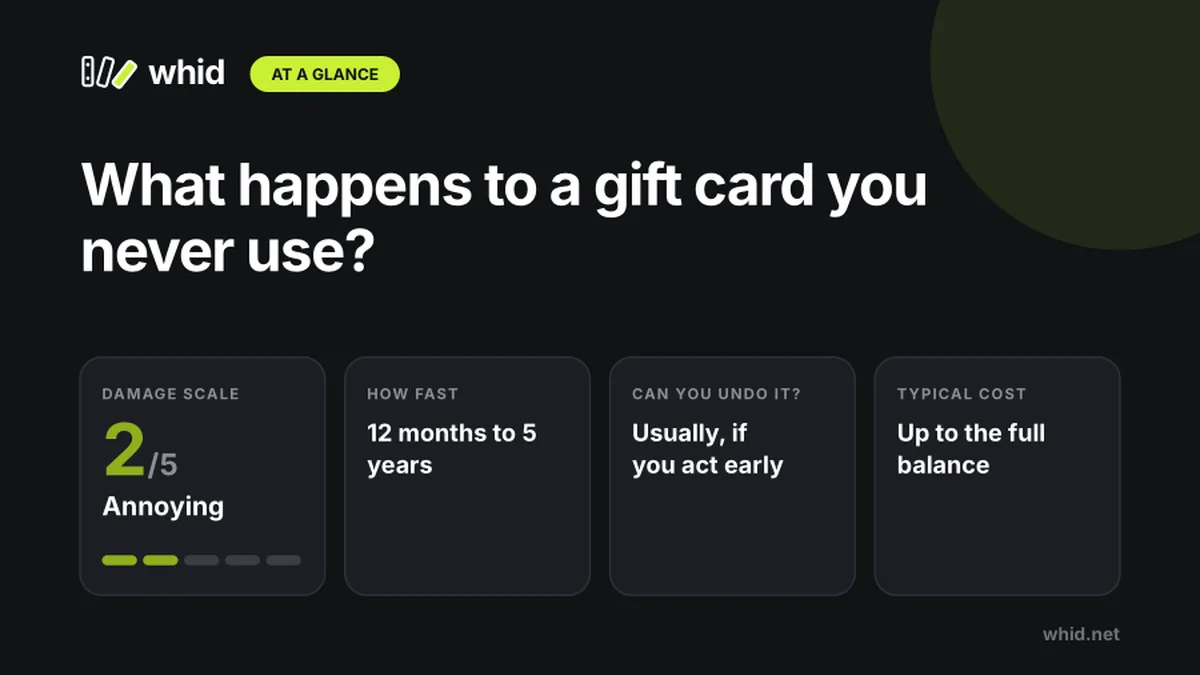
At a glance: What happens to a gift card you never use? Damage scale 2/5 (Annoying); how fast: 12 months to 5 years; typical cost: Up to the full balance.
At a glance: the damage rating, how fast it happens, whether it can be undone and what it usually costs.

The federal baseline: five years and twelve months

The Credit Card Accountability Responsibility and Disclosure Act of 2009, known as the CARD Act, set the floor for gift cards sold since August 22, 2010. A card cannot expire earlier than five years after the date it was issued or the date money was last loaded onto it. Inactivity, dormancy and service fees are banned until the card has gone a full 12 months without use, and even then only one fee may be charged in a month. Any fee has to be disclosed on the card or its packaging.
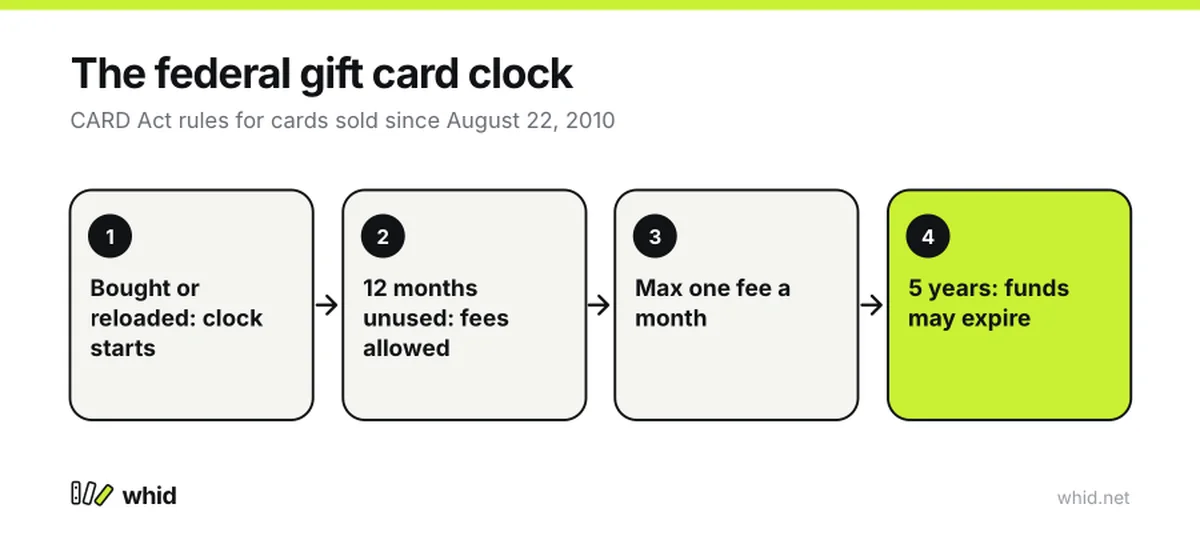
Four steps of the federal gift card rules: clock starts at purchase, fees allowed after 12 months unused, one fee per month, funds may expire after five years
Adding money restarts the five-year clock.

Two details matter here. First, the five-year clock restarts whenever money is added, so a reloadable card you top up keeps renewing. Second, an expiration date printed on the plastic is not always the end of the money. If the card itself expires before the funds do, the issuer generally has to send a replacement at no charge.

The rules do not cover everything. Promotional cards, such as "$10 off your next visit" handed out free, and loyalty reward cards can still expire quickly. If you did not pay for it, read the terms before assuming you have five years.

Where the money actually leaks out

Store cards rarely charge fees in practice. Most big retailers have dropped them, and many states ban them outright. The real risk with a store card is not a fee but the store itself. When a chain goes bankrupt or closes for good, unused gift cards can become worthless, or be honored for only a short window during liquidation.

Network prepaid cards are different. Many charge a monthly maintenance fee once the 12-month inactivity period has passed, often a few dollars. On a small balance that fee does real damage. A $50 card with a $3 monthly fee keeps its full value for its first year, is down to $32 after 18 months and is completely empty a little after two years. Nobody spent a cent of it.

There is also the leftover problem. Cards often end with an awkward few dollars that never quite match a purchase. Those small amounts are exactly what sits in drawers for years.
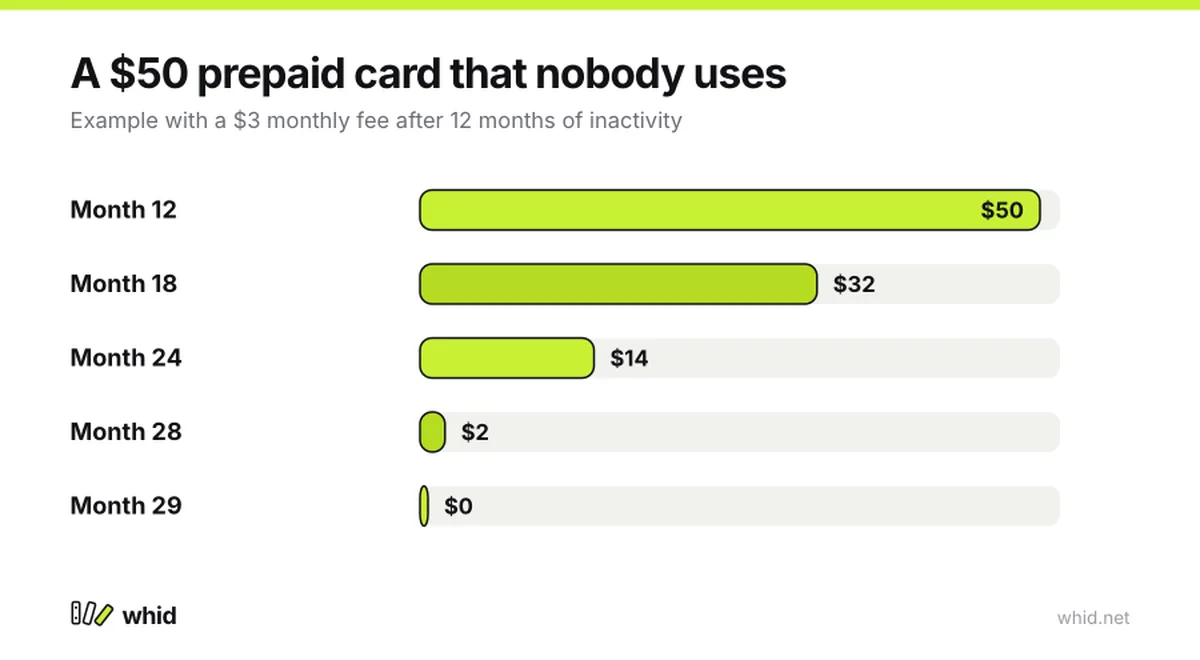
Bar chart showing a $50 prepaid gift card falling to $32 at 18 months, $14 at 24 months and $0 by month 29 because of a $3 monthly fee
Our example: the fee only starts after a year, then empties the card in about 17 more months.

State laws often go further

The CARD Act is a minimum, and states are allowed to be stricter. California, for example, bans expiration dates on most store gift cards and lets you redeem a balance under $10 for cash. Several other states have similar cash-out rules for small remaining balances, and some ban dormancy fees entirely or delay them for years.

A few states treat long-unused gift card balances as unclaimed property that the issuer must report and hand over to the state after a dormancy period, while many others exempt gift cards from those rules. Because it varies so much, the quickest check is your state attorney general's or consumer protection office's page on gift cards.

How to rescue a forgotten card

Start by checking the balance online or on the number printed on the back. It takes a minute and tells you whether fees have already started. If the card has expired but the money has not, contact the issuer and ask for a replacement card or a transfer of funds.

If you know you will never shop at that store, you have options. Use the balance on something you already buy there, such as household basics. Ask whether your state lets you cash out a small leftover. Or sell the card on a reputable gift card exchange, accepting a discount of roughly 10% to 30%. Giving it to someone who shops there is also better than letting it age.

For network prepaid cards, the advice is blunt: spend them within the first year. Split a purchase at checkout if the balance is smaller than the total. Most cashiers can run the card for its exact balance and take the rest on another payment method.
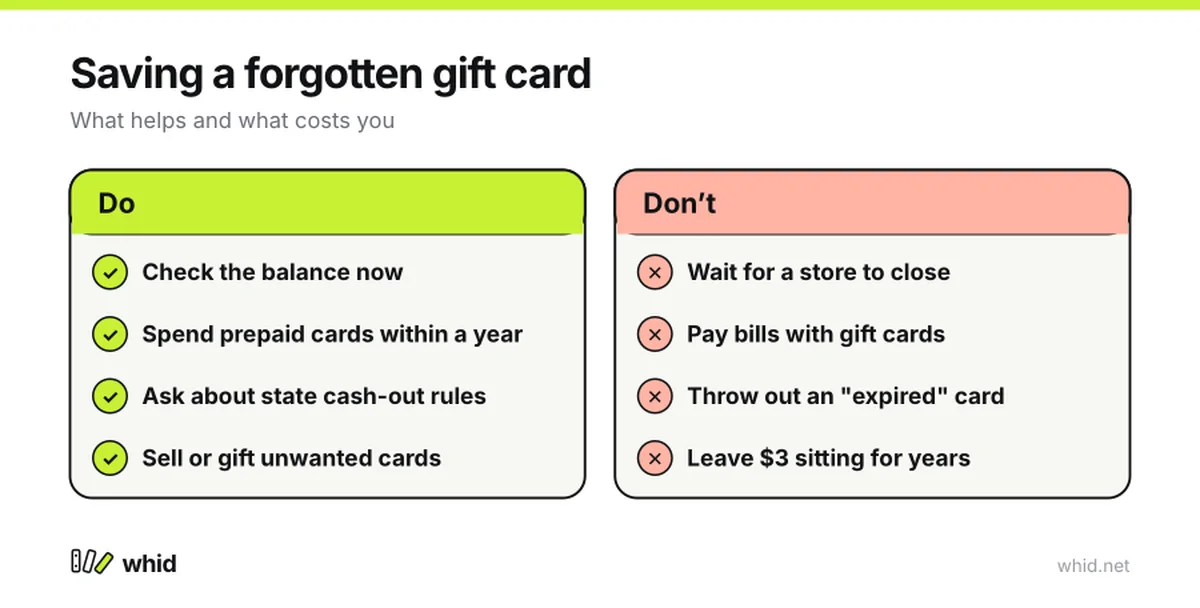
Do and don't list for unused gift cards
Five minutes with a drawer full of cards can be worth real money.

Digital gift cards and store credit

E-gift cards sent by email are covered by the same federal rules as plastic ones, but they are easier to lose. Search your inbox for words like gift card, e-gift or redeem, and add any codes you find to the retailer's app or account so the balance is stored there. Many retailers let you load a gift card onto your account permanently.

When a gift card might not be what it seems

Gift cards are also a favorite tool of scammers, because they are hard to trace. No government agency, utility or legitimate company will ask you to pay a bill or a fine with gift cards. If someone does, it is a scam, and the FTC asks people to report it. Keeping the receipt when you buy a card, and the card number when you receive one, makes it far easier to get help if a card is drained or lost.

The simplest habit costs nothing: each time you clean out a wallet or a drawer, put any gift cards you find into one envelope with a sticky note of the balance. The money is real, and it is easy to keep.

02 Gift card types compared

Federal rules shown. Many states are stricter.

Card typeCan it expire?Fees after 12 months idle?Biggest risk
Store gift cardNot before 5 yearsAllowed, but rareStore closing or bankruptcy
Visa / Mastercard prepaid gift cardNot before 5 yearsCommonMonthly fees eating the balance
Promotional or free cardYes, often quicklyNot coveredShort expiration date
Loyalty reward cardYesNot coveredProgram rules change

03 What to do right now

  1. Check the balance today Use the website or phone number on the back. It shows whether fees have started.
  2. Spend prepaid cards within a year Network cards are the ones most likely to charge monthly fees after 12 months.
  3. Ask about cash-out Some states let you redeem small leftover balances, such as under $10 in California, for cash.
  4. Sell or gift what you won't use A reputable exchange pays part of the value. That beats a card that slowly drains.

04 Myth vs fact

Myth The date printed on the card is when the money disappears.

Fact The funds usually last at least five years from issue or last load, and the issuer must replace an expired card for free.

Myth Gift cards never lose value.

Fact Network prepaid cards can charge monthly fees after 12 months without use.

Myth If a store goes bankrupt, your card is protected.

Fact Gift card holders are usually unsecured creditors and may get little or nothing.

05 Has this happened to you?

Real experiences from readers. Stories are checked by an editor before they appear and are not professional advice.

No reader stories yet — be the first to share yours.

Share what happened to you

By sending, you agree that we may publish your story (first name and location only). See our privacy policy.

06 Quick questions

Do gift cards expire in the US?

Not before five years from the date issued or last loaded, under the CARD Act. Many states ban expiration on store cards entirely.

Can I get cash for a gift card balance?

In some states yes, for small remaining balances. California allows it for balances under $10.

What happens to my gift card if the store closes?

It may be honored briefly during a liquidation or not at all. Use cards from struggling retailers quickly.

Why did my Visa gift card balance go down?

Most likely a monthly inactivity fee, which is allowed after 12 months without use if it was disclosed.

Sources

  1. Federal Register – Electronic Fund Transfers final rule (gift cards), 2010
  2. Consumer Reports – State gift card consumer protection laws
  3. Montgomery County, MD – Unwrapping gift cards
  4. FTC – Gift card scams

General information only. Laws, prices and procedures vary by location and change over time — check with a qualified professional for your situation. Full disclaimer.