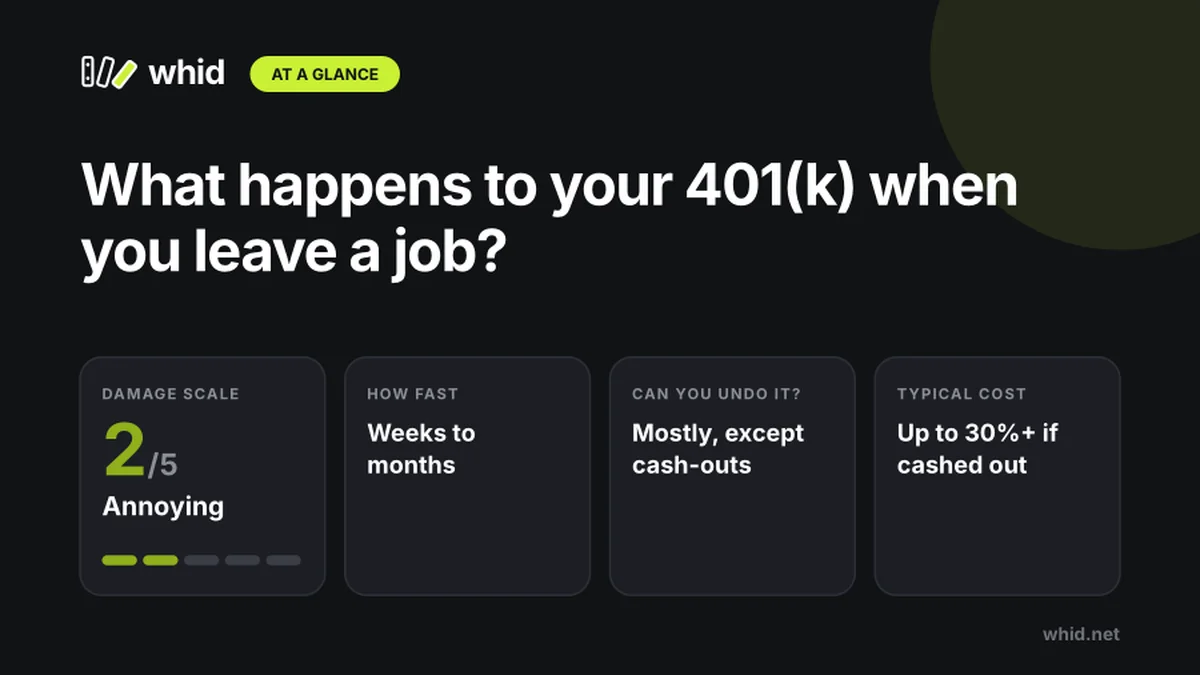
Leaving a job comes with a pile of paperwork, and the 401(k) is the item people most often put off. That is understandable, because nothing urgent seems to happen. The account keeps its balance, the investments keep moving with the market, and the statements keep arriving for a while. But the old plan does not have to hold your money forever, and the default choices are not always the good ones.
The first thing to know is what is actually yours. Every dollar you contributed from your paycheck belongs to you, along with whatever it has earned. Employer matching money is yours only once it has vested. Plans can use a cliff schedule of up to three years or a graded schedule of up to six. If you leave before you are fully vested, the unvested part of the match goes back to the plan.
Your balance decides the default
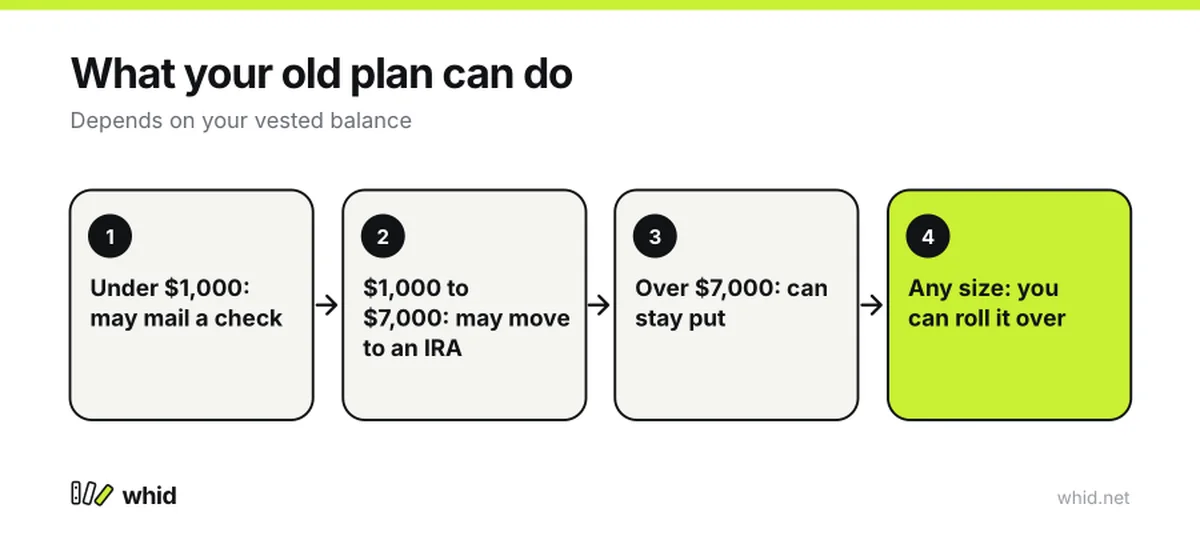
Plans are allowed to push out small accounts after you leave, which saves them administration costs. The SECURE 2.0 Act raised the limit for these forced distributions from $5,000 to $7,000 for distributions after the end of 2023, although each plan has to adopt the higher number.
In practice it works in three tiers. Balances under $1,000 are often cashed out with a check sent to your last known address. Balances between $1,000 and the plan's limit, $7,000 at most, must be rolled into an IRA opened in your name if you do not give instructions, usually called a safe harbor IRA. Balances above the limit can stay in the old plan as long as you like, until you reach the age for required distributions.
That automatic IRA protects you from taxes, but it often sits in a cash-like investment earning very little, and some charge annual fees that eat into a small balance. If you have moved and the plan cannot reach you, it is easy to lose track of it completely.
What cashing out really costs
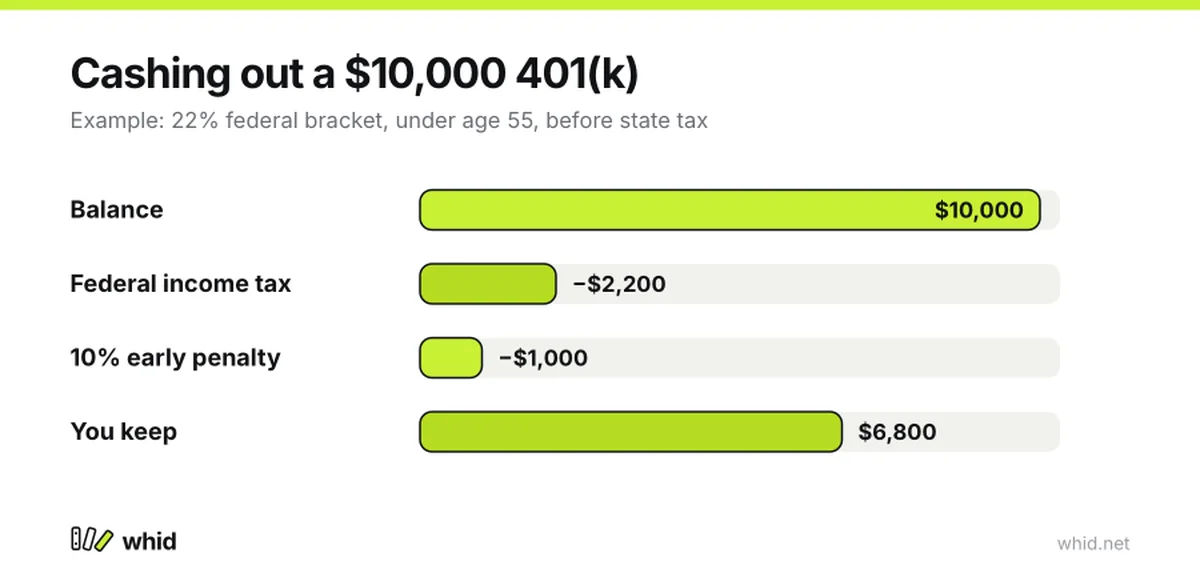
Taking the money as cash is the one choice that is hard to undo. When a plan pays a distribution to you directly, it must withhold 20% for federal income tax. The full amount then counts as income for the year, and if you are under 59½ you usually owe an extra 10% early withdrawal penalty on top. State income tax may apply as well.
Take a $10,000 balance and someone in the 22% federal bracket who is under 55. Income tax takes about $2,200, the penalty another $1,000, and they keep roughly $6,800 before state tax. Beyond the immediate hit, they lose every year of future growth on that money.
There is an important exception. If you leave your job in or after the year you turn 55, withdrawals from that employer's plan are not subject to the 10% penalty. This rule of 55 applies only to the plan you just left, not to IRAs, which is one reason not to roll everything into an IRA without thinking about timing.
The 401(k) loan trap
If you borrowed from your 401(k), leaving usually brings the loan due. Whatever is not repaid gets treated as a distribution, which means income tax and possibly the 10% penalty. Since 2018, though, you have until your tax return due date, including extensions, to deposit the unpaid amount into an IRA or new plan and avoid the tax. Many people never hear about that window, so ask the plan for the exact figure and the deadline.
Your four real options
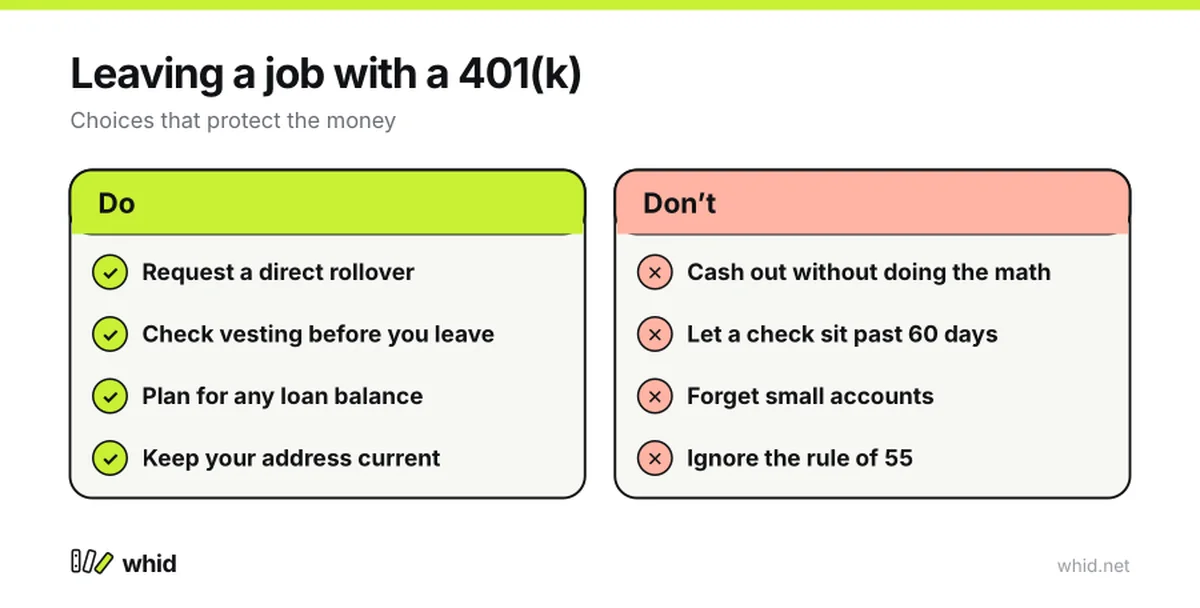
You can leave the money where it is, if the balance is large enough. That makes sense when the old plan has low-cost funds or you might use the rule of 55. You can roll it into your new employer's plan, which keeps everything in one place and preserves strong legal protection from creditors. You can roll it into an IRA, which gives you the widest choice of investments. Or you can cash it out, which is almost always the most expensive option.
For either kind of rollover, ask for a direct rollover, where the money moves straight from one plan to the other. If a check is made out to you instead, 20% is withheld and you have 60 days to deposit the full original amount, making up the withheld part from your own pocket, or the shortfall is taxed.
Questions to ask before you choose
Before you move anything, it helps to compare what the old plan actually costs. Ask for the plan's fee disclosure, which lists the expense ratios of each fund and any administrative charges. Large employer plans often have access to institutional share classes that are cheaper than what an individual can buy in an IRA, which is a real reason to leave money where it is. Smaller plans can be the opposite.
Also ask whether the plan lets former employees take partial withdrawals, because some only allow all-or-nothing distributions. And if you own company stock inside the 401(k), talk to a tax professional before rolling it over: special rules on net unrealized appreciation can make it cheaper to move that stock to a regular brokerage account instead.
How to find an old 401(k)
If you have lost track of an account, start with an old W-2: box 12 shows retirement contributions, and the employer's HR or benefits office can tell you who runs the plan. The Department of Labor also runs a Retirement Savings Lost and Found database created under SECURE 2.0, which lets you search for plans tied to your Social Security number. Updating your address with every old plan when you move is the easiest way to keep this from happening.